
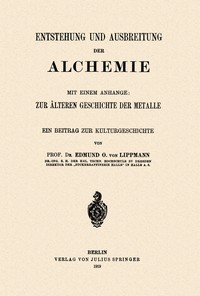
Entstehung und Ausbreitung der Alchemie, mit einem Anhange : zur älteren…
Let's be clear from the start: this isn't a novel. Edmund O. von Lippmann's Entstehung und Ausbreitung der Alchemie (The Origin and Spread of Alchemy) is a serious work of historical scholarship, first published in 1919. But don't let that scare you off. Think of it as the ultimate origin story for one of history's most misunderstood pursuits.
The Story
Lippmann isn't just listing facts and dates. He's on a mission to map a migration. The book starts by asking a deceptively simple question: where and when did the core ideas of alchemy first appear? He argues against a single, neat origin point. Instead, he pieces together evidence from ancient Egypt, showing how early metalworking and color-making practices mixed with Greek philosophy and mystical beliefs. The plot, so to speak, follows this hybrid idea as it travels. He shows how it was picked up, transformed, and advanced by scholars in the Islamic world during the Middle Ages, who gave it the Arabic name al-kimiya. Finally, he traces its path into medieval Europe, where it took on new life in monasteries and courts. The 'conflict' in the story is the constant tension between the practical, experimental side of alchemy (the ancestor of chemistry) and its spiritual, symbolic side. Lippmann shows they were never really separate.
Why You Should Read It
This book completely changed how I see alchemy. It stops being a joke about greedy fools and starts looking like a centuries-long, international conversation about the nature of matter and transformation. Lippmann's research is meticulous—you can feel him sifting through ancient texts and fragments—but his fascination is contagious. He makes you care about how knowledge moves. You see connections between cultures you might not have linked before. The included appendix on older sources is like a bonus chapter of detective work, showing how historians untangle these ancient threads. It's a reminder that our modern categories of 'science,' 'religion,' and 'art' didn't always exist, and alchemy lived in all those spaces at once.
Final Verdict
This is a book for the curious non-specialist who loves intellectual history. If you enjoy books that explore the roots of scientific ideas, like where math or medicine came from, you'll find this gripping. It's perfect for readers of popular history who want to go a bit deeper into a specific, fascinating topic. Be warned: it's a dense, academic text (and in German, though translations exist), so it requires some focus. But if you stick with it, you'll be rewarded with a profound understanding of one of the most influential thought systems in human history. You'll never look at a history of science timeline the same way again.
This is a copyright-free edition. Access is open to everyone around the world.



James Young
6 months agoNot bad at all.