
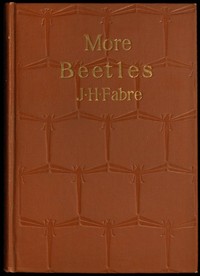
More Beetles by Jean-Henri Fabre
Jean-Henri Fabre's 'More Beetles' is a collection of his detailed observations on, you guessed it, beetles. But calling it a book about bugs is like calling a symphony a bunch of notes. Fabre didn't just look at beetles; he lived with them. He spent decades in his little patch of Provence, watching their daily routines with the patience of a saint and the curiosity of a detective.
The Story
There's no traditional plot. Instead, each chapter focuses on a different beetle or group of beetles. We meet the Sacred Scarab, the famous dung-roller, and follow its epic struggle to move a ball of food across rough terrain, often fighting off thieves. We watch the Minotaur Beetle dig deep burrows and carefully provision them for its young. We see the fierce predatory tactics of ground beetles and the delicate architecture of weevils. Fabre sets up little experiments—blocking a beetle's path, moving its food, changing the lighting—to test their instincts and intelligence. The 'story' is the unfolding drama of their survival, their parenting, and their constant struggle in a miniature world.
Why You Should Read It
You should read it because Fabre makes you care. His writing is full of genuine wonder. He gets frustrated when a beetle is stubborn, amazed when it solves a problem, and respectful of its ancient, hardwired knowledge. He isn't a cold scientist; he's a storyteller. Through his eyes, a pile of dung becomes a precious resource, and a hole in the ground becomes a carefully engineered nursery. The book slows you down. In our fast-paced world, it's a joy to read about someone who found a lifetime of fascination in things most of us step on. It reminds you that incredible stories are happening right under your feet.
Final Verdict
This book is perfect for nature lovers, curious minds, and anyone who needs a reminder to look closer at the world. It's great for readers who enjoy quiet, thoughtful non-fiction. If you liked 'Braiding Sweetgrass' or the essays of Annie Dillard, you'll appreciate Fabre's blend of science and soul. It might be a harder sell for someone who needs a fast-paced thriller, but for the right reader, it's a complete and captivating escape into a tiny, astonishing universe.
No rights are reserved for this publication. Use this text in your own projects freely.
William Taylor
6 months agoI appreciate how this edition approaches the core problem, the clarity of the writing makes even the most dense sections readable. I'm glad I chose this over the other alternatives.
Elizabeth Perez
5 months agoImpressive quality for a digital edition.
Mary Lopez
5 months agoThe balance between academic rigor and readability is perfect.
John Wilson
2 months agoRight from the opening paragraph, the way it challenges the status quo is both daring and well-supported. Finally, a source that prioritizes accuracy over hype.
Patricia Smith
7 months agoI was particularly interested in the case studies mentioned here, the author clearly has a deep mastery of the subject matter. A refreshing and intellectually stimulating read.