
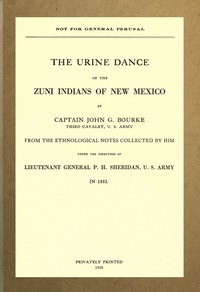
The urine dance of the Zuni Indians of New Mexico by John Gregory Bourke
Published in 1885, this isn't a novel with a plot in the traditional sense. It's a first-hand ethnography, a report. Captain John Gregory Bourke, stationed in the Southwest, witnessed and recorded a specific Zuni ceremony. The book is his attempt to describe the ritual, often called the 'Urine Dance' or 'Paiyatuma' ceremony, which was part of a larger, complex series of rites related to fertility, rain, and healing.
The Story
Bourke lays out what he saw with the methodical eye of a soldier and the curiosity of an amateur anthropologist. He describes the participants, their body paint, the rhythmic steps, and the ceremonial use of urine—a substance seen not as waste, but as a potent, life-connected element in Zuni cosmology. He notes the songs, the gestures, and the serious, sacred atmosphere. There's no character arc, but the 'character' is the ceremony itself, and the tension comes from Bourke's position. He's an agent of the government that is actively subjugating Native nations, yet he's trying to preserve knowledge of their practices. The story is the act of observation itself.
Why You Should Read It
This book is a punch to the gut of easy assumptions. It forces you to sit with discomfort—the discomfort of the title, the discomfort of a sacred act being dissected by an outsider, and the discomfort of history's messy collisions. You're not getting a neat, modern analysis. You're getting raw, unfiltered 1885. Reading it, I kept thinking about who gets to write history, and how. Bourke's account is invaluable because it exists, but it's also deeply problematic. It’s a primary source that shows both respect and a fundamental cultural gap. It made me actively question what I was reading, which is a powerful experience for such a short work.
Final Verdict
This is not for everyone. It's a niche, academic-adjacent text. But if you're a history nerd who loves primary sources, someone interested in the complex ethics of anthropology, or a reader fascinated by 19th-century encounters between cultures, you need to find this. It's perfect for anyone tired of sanitized history and ready to grapple with a strange, difficult, and utterly captivating artifact. Just be prepared to do some thinking alongside your reading.
This work has been identified as being free of known copyright restrictions. Knowledge should be free and accessible.
John Lopez
2 years agoThe peer-reviewed feel of this content gives me great confidence.
Donald Brown
2 years agoThe layout of the digital version made it easy to start immediately, the structural organization allows for quick referencing of key points. I'll be citing this in my upcoming project.
Christopher Thompson
2 years agoThe digital formatting makes it very easy to navigate.
Barbara Taylor
11 months agoComparing this to other titles in the same genre, the argument presented in the middle section is particularly compelling. Simple, effective, and authoritative – what else could you ask for?






James Taylor
3 weeks agoThe layout of the digital version made it easy to start immediately, the historical context mentioned in the early chapters is quite enlightening. I am looking forward to the author's next publication.