About 834 minutes
A History of Matrimonial Institutions, Vol. 2 of 3 — Key Ideas to Explore
Historical Psychological Social Fiction
191,746 recorded words. 224 minutes difference from this book's estimate.
View Gutenberg source #49247
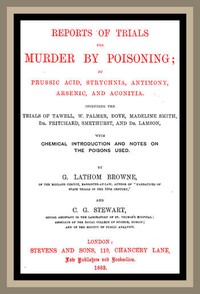
For Reports of Trials for Murder by Poisoning; by Prussic Acid, Strychnia, Antimony, Arsenic, and Aconita. Including the trials of Tawell, W. Palmer, Dove, Madeline Smith — Reading Companion, the stored edition analysis reports 243,303 words, 17 hr 38 min estimated reading time, and 38 detected text sections.
The text analysis averages about 19.2 words per sentence, while the detected sections provide another way to judge how the source is divided.
Project Gutenberg metadata also associates the work with “Poisons,” connecting these edition facts with the source record’s subject description.
Explore this collection
These alternatives are selected using recorded categories and estimated reading time.
About 834 minutes
Historical Psychological Social Fiction
191,746 recorded words. 224 minutes difference from this book's estimate.
View Gutenberg source #49247About 545 minutes
Historical Psychological Social Fiction
125,260 recorded words. 513 minutes difference from this book's estimate.
View Gutenberg source #69404About 465 minutes
Historical Psychological Social Fiction
106,921 recorded words. 593 minutes difference from this book's estimate.
View Gutenberg source #101Search stored excerpts and compare books → Choose by your preferences →
Choices use stored catalog measurements. Estimates vary with reading speed. A shared category is a catalog label, not a claim that two books have the same argument or literary quality.
Search reads excerpt text stored with this catalog and links to its associated Gutenberg record. The connection is stored in the site database; this tool does not recheck that every excerpt is word-for-word identical to that external record. Excerpt search does not cover every chapter and does not verify historical publication dates.
Catalog snapshot checked: 2026-09-26. Coverage: 99 public books, 99 available source excerpts.
Calculated from edition completeness, EPUB availability, text structure and catalogue metadata. Not a user rating.
Total of 100 points, scaled to a 2.5-5.0 range. Editions with an empty description or a missing EPUB file are not scored.
Public-domain source text
The source text is kept in the dedicated reader, separate from this catalogue record and its commentary.
This volume, published in 1883, collects reports of seven celebrated poisoning trials from the preceding half-century, each paired with a chemical introduction and notes on the poisons involved. The editors—a barrister and a laboratory assistant—explicitly aim to serve both the legal and medical professions, emphasizing the detailed reproduction of medical and chemical testimony, especially where expert witnesses contradicted one another. The excerpts show that the book is not a narrative of crimes but a record of evidentiary procedure: the cross-examination of a witness about arsenic doses, for instance, occupies several pages, with the examiner pressing for specific recollections of grain quantities found in stomachs.
The excerpts reveal a courtroom dynamic in which medical witnesses are pressed to distinguish poisoning from natural disease. One witness, asked whether symptoms could arise from malignant cholera, concedes that a sense of choking and soreness of the throat points more specifically to arsenic. The questioning then turns to dosage: the witness states that in arsenic poisoning, the amount found in the stomach is always larger than necessary, because death results from what disappears from the stomach, not what remains. The examiner challenges this inference, asking for examples of comparable doses—88 grains—in murder cases. The witness cannot recall any, but refuses to rely on a negative recollection. This exchange illustrates how the book preserves the texture of adversarial science.
The preface notes that shorthand writers, though generally reliable, often mangle scientific terms, and that even a single letter’s error can be significant. To address this, the editors state they have verified the nomenclature and supplemented the reports with recent experiments on disputed points. The excerpts include precise phrasing such as “duodenitis” and references to “the ordinary time that elapses between the administration of arsenic and death” (eighteen hours to two and a half days, with anomalous shorter intervals). This attention to technical accuracy suggests the volume was designed as a reference work, not a popular account.
A striking feature of the testimony is the tension between statistical generalization and case-specific evidence. The witness acknowledges that large doses are common in suicide but avoids stating that murderers also use excess poison, though he admits that “murder, even by injuries, and also by poison, is very often detected by the size of the dose.” The examiner seizes on this, suggesting that a prudent poisoner would avoid a conspicuously large dose. The witness’s cautious replies—hedged with “I cannot recollect,” “I would not rely on my recollection”—highlight the limits of empirical knowledge in the courtroom. The book thus documents not only what was known about poisons, but how that knowledge was tested under cross-examination.
Readers approaching this work should expect a dense record of legal procedure rather than a true-crime narrative. The value lies in the interplay between the barrister’s framing of testimony and the chemist’s explanatory notes. Because the excerpts are incomplete, the full scope of the seven trials and the chemical essays remains unknown, but the editorial method—prioritizing verbatim expert evidence and correcting scientific terminology—is evident throughout.
Reading the poison trials, I felt the grim precision—arsenic grains weighed in glass vials, expert voices colliding. It reminded me of another volume, quieter in tone, where the same sharp scrutiny fell upon politics and character rather than chemistry: State Trials, Political and Social. Volume 2 (of 2) — Story, Setting & Ideas. Both hold that odd, solemn hum of courtroom air.
Build a private reading journal entry for this title.