About 216 minutes
The Quaker Colonies: A Chronicle of the Proprietors of the Delaware — Reading Companion
Historical Psychological Social Fiction
49,660 recorded words. 14 minutes difference from this book's estimate.
View Gutenberg source #3043
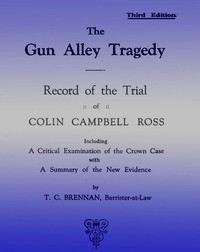
For The Gun Alley Tragedy: Record of the Trial of Colin Campbell Ross — Themes and Context, the stored edition analysis reports 46,239 words, 3 hr 22 min estimated reading time, and 10 detected text sections.
The text analysis averages about 21.8 words per sentence, while the detected sections provide another way to judge how the source is divided.
Project Gutenberg metadata also associates the work with “Ross, Colin Campbell, 1892-1922 -- Trials, litigation, etc.,” connecting these edition facts with the source record’s subject description.
Explore this collection
These alternatives are selected using recorded categories and estimated reading time.
About 216 minutes
Historical Psychological Social Fiction
49,660 recorded words. 14 minutes difference from this book's estimate.
View Gutenberg source #3043About 217 minutes
Historical Psychological Social Fiction
49,825 recorded words. 15 minutes difference from this book's estimate.
View Gutenberg source #44273About 226 minutes
Historical Psychological Social Fiction
51,804 recorded words. 24 minutes difference from this book's estimate.
View Gutenberg source #12427Search stored excerpts and compare books → Choose by your preferences →
Choices use stored catalog measurements. Estimates vary with reading speed. A shared category is a catalog label, not a claim that two books have the same argument or literary quality.
Search reads excerpt text stored with this catalog and links to its associated Gutenberg record. The connection is stored in the site database; this tool does not recheck that every excerpt is word-for-word identical to that external record. Excerpt search does not cover every chapter and does not verify historical publication dates.
Catalog snapshot checked: 2026-09-26. Coverage: 99 public books, 99 available source excerpts.
Calculated from edition completeness, EPUB availability, text structure and catalogue metadata. Not a user rating.
Total of 100 points, scaled to a 2.5-5.0 range. Editions with an empty description or a missing EPUB file are not scored.
Public-domain source text
The source text is kept in the dedicated reader, separate from this catalogue record and its commentary.
T. C. Brennan, who served as junior counsel for the defence, opens this record by stating that the trial of Colin Campbell Ross for the murder of Alma Tirtschke created a public sensation unmatched in Australian history. He notes that Ross was convicted almost entirely on two alleged confessions, which he strenuously denied. Brennan’s preface frames the work as a dispassionate review of proceedings that occurred in an inflamed atmosphere, and he explicitly states that the question of whether Ross actually made the statements attributed to him by Ivy Matthews and John Harding remains unanswered.
Brennan’s book is not a straightforward trial transcript. It is a third edition that includes a critical examination of the Crown case and a summary of new evidence. The excerpts show that Brennan juxtaposes the testimonies of Matthews and Harding, placing their statements side by side to highlight contradictions. For example, he points out that Matthews claimed Ross said he carried the body out of a cubicle into a beaded room, while Harding’s version has Ross denying that Gladys could see the girl because they drank in the parlour. Brennan also notes that Harding’s account of a tram diversion was contradicted by three casual acquaintances who travelled home with Ross that night.
Brennan’s approach is forensic. He dissects the confessions by testing them against known facts. For instance, he observes that Harding makes Ross say he returned from Footscray by push bike, but Brennan notes that Ross had no bicycle of his own and that detectives had already satisfied themselves that Ross did not return by car. Brennan also highlights that Harding’s timeline for Ross’s return is about an hour earlier than independent testimony showed. The analysis is precise: Brennan argues that Matthews and Harding, knowing certain facts from an outside source, were compelled to fill in gaps in their own way.
Brennan repeatedly emphasises that the jury’s verdict did not resolve the central question: did Ross actually say what Matthews and Harding claimed? He calls this the enduring mystery of the Ross trial. The excerpts show that Brennan is careful not to assert Ross’s innocence or guilt; instead, he focuses on the unreliability of the confessions. He points out that Harding’s narrative carries on its face the mark of falsehood, and he notes that the defence knew exactly how the story of a tram disturbance originated—a witness’s statement was misunderstood by police. Brennan’s work is a call for calm scrutiny of evidence in a case where public opinion was inflamed.
Readers approaching this record should attend to Brennan’s method: he does not present a complete trial transcript but selects and analyses evidence to expose inconsistencies. The excerpts are incomplete, so the full scope of his argument is not visible here, but his focus on the confessions of Matthews and Harding is clear. This is a work of legal analysis, not a narrative, and its value lies in its meticulous dissection of witness testimony.
Reading Brennan’s quiet, relentless dissection of the Ross confessions, I remembered sitting alone with an old casebook, the same strange hush falling over the room—that sense of a life already ended, yet somehow still pleading from the page. State Trials, Political and Social. Volume 1 (of 2) — A Reader’s Guide gave me that identical ache, the weight of words that decided things.
Your answers remain private and are stored only in this browser.