About 346 minutes
State Trials, Political and Social. Volume 1 (of 2) — A Reader’s Guide
Historical Psychological Social Fiction
79,369 recorded words. 7 minutes difference from this book's estimate.
View Gutenberg source #27515
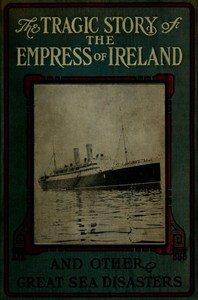
The source record for The Tragic Story of the Empress of Ireland, and Other Great Sea Disasters — Reading Companion measures this digital text at 77,908 words, 5 hr 39 min estimated reading time, and 35 detected text sections.
The text analysis averages about 18.7 words per sentence, while the detected sections provide another way to judge how the source is divided.
Project Gutenberg metadata also associates the work with “Shipwrecks,” connecting these edition facts with the source record’s subject description.
Explore this collection
These alternatives are selected using recorded categories and estimated reading time.
About 346 minutes
Historical Psychological Social Fiction
79,369 recorded words. 7 minutes difference from this book's estimate.
View Gutenberg source #27515About 363 minutes
Historical Psychological Social Fiction
83,368 recorded words. 24 minutes difference from this book's estimate.
View Gutenberg source #52301About 299 minutes
Historical Psychological Social Fiction
68,649 recorded words. 40 minutes difference from this book's estimate.
View Gutenberg source #7076Search stored excerpts and compare books → Choose by your preferences →
Choices use stored catalog measurements. Estimates vary with reading speed. A shared category is a catalog label, not a claim that two books have the same argument or literary quality.
Search reads excerpt text stored with this catalog and links to its associated Gutenberg record. The connection is stored in the site database; this tool does not recheck that every excerpt is word-for-word identical to that external record. Excerpt search does not cover every chapter and does not verify historical publication dates.
Catalog snapshot checked: 2026-09-26. Coverage: 99 public books, 99 available source excerpts.
Calculated from edition completeness, EPUB availability, text structure and catalogue metadata. Not a user rating.
Total of 100 points, scaled to a 2.5-5.0 range. Editions with an empty description or a missing EPUB file are not scored.
Public-domain source text
The source text is kept in the dedicated reader, separate from this catalogue record and its commentary.
Logan Marshall's account of the Empress of Ireland disaster, published in 1914, is notable for its dual focus: the immediate catastrophe and a broader context of the St. Lawrence River's geological and historical significance. The book opens with a stark fact box listing 1,078 dead, then shifts to a detailed description of Montreal as a meeting place of English and French races, church and commerce. This juxtaposition creates a tension between the sudden, man-made tragedy and the ancient, slow-moving forces that shaped the river's basin.
The excerpts reveal a deliberate structural contrast. The disaster narrative is compressed: the Empress of Ireland sinks in about fifteen minutes, with Captain Kendall's and Captain Andersen's conflicting statements presented in separate chapters. In contrast, the geological description of the St. Lawrence valley reaches back to "the most ancient period of the world's evolution," describing volcanic upheavals and ice flows that created the basin over eons. The text notes that the 1663 earthquake along the lower St. Lawrence lasted months, causing landslides and turning the river "white as milk." This juxtaposition of a fifteen-minute sinking with geological ages suggests a human drama set against an indifferent, monumental landscape. The book does not explicitly connect these scales, leaving readers to ponder the relationship between human error and natural forces.
Among the factual data, the book highlights that the Salvation Army delegation numbered 150, of whom 124 were lost. This statistic is given without narrative elaboration in the excerpts, but it appears in the same fact box as the total passenger count. The delegation's presence is later referenced in a chapter titled "Crippling Loss to the Salvation Army." The excerpts do not reveal the identities or stories of these individuals, but the precise number—124 lost out of 150—underscores the disproportionate impact on a single organized group. This detail, presented as raw data, contrasts with the more general accounts of heroism and survival in later chapters. It invites readers to consider how the disaster affected specific communities, though the book's structure keeps such analysis implicit.
The book devotes a chapter to "The St. Lawrence: A Beautiful River," which describes the river's geography and history, including the fort built at Sorel in 1642. This descriptive passage stands apart from the disaster narrative, yet it frames the setting of the collision. The river is portrayed as both a commercial artery and a site of ancient violence: "upheavals of a volcanic character are obvious around Montreal," and the 1663 earthquake made "the forests... as though they were drunk." This language of geological convulsion echoes the sudden violence of the shipwreck. By embedding the disaster within a longer history of natural upheaval, the book subtly suggests that the St. Lawrence is not merely a backdrop but an active, unpredictable force. The chapter's placement after the immediate accounts of the sinking reinforces this sense of a landscape that has witnessed many catastrophes.
Readers approaching this work should note its hybrid structure: it is part contemporary journalism, part historical geography. The appended sections on the Titanic and other marine disasters further broaden the scope. Pay attention to how factual lists—passenger counts, survivor numbers—sit alongside descriptive prose. The book's value lies less in a unified narrative than in the contrasts it presents between human agency and natural forces, between statistical summary and personal testimony.
I keep thinking about Logan Marshall’s book, how the geological descriptions of the St. Lawrence feel like a quiet, patient backdrop to the sudden tragedy. That odd stillness reminded me of something else—the way rules and landscapes shift beneath us. It made me think of The Hacker Crackdown: Law and Disorder on the Electronic Frontier — Edition Insights, where the emerging digital world similarly holds its breath before the crackdown comes. Both feel like watching tides turn.
Save your reaction, strongest insight, and memorable passage.