About 81 minutes
Churchwardens' Manual their duties, powers, rights, and privilages — Background and Themes
Fantasy Juvenile Worlds
18,573 recorded words. 26 minutes difference from this book's estimate.
View Gutenberg source #23476
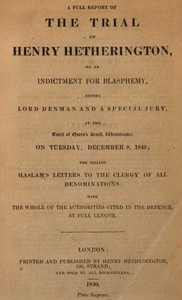
The catalog record for The Trial of Henry Hetherington, on an Indictment for Blasphemy — A Reader’s Guide provides practical reading context through 24,567 words, 1 hr 47 min estimated reading time, and 13 detected text sections.
The text analysis averages about 26.4 words per sentence, while the detected sections provide another way to judge how the source is divided.
Project Gutenberg metadata also associates the work with “Hetherington, H. (Henry), 1792-1849 -- Trials, litigation, etc.,” connecting these edition facts with the source record’s subject description.
Explore this collection
These alternatives are selected using recorded categories and estimated reading time.
About 81 minutes
Fantasy Juvenile Worlds
18,573 recorded words. 26 minutes difference from this book's estimate.
View Gutenberg source #23476About 78 minutes
Fantasy Juvenile Worlds
17,779 recorded words. 29 minutes difference from this book's estimate.
View Gutenberg source #54042About 139 minutes
Fantasy Juvenile Worlds
31,808 recorded words. 32 minutes difference from this book's estimate.
View Gutenberg source #39148Search stored excerpts and compare books → Choose by your preferences →
Choices use stored catalog measurements. Estimates vary with reading speed. A shared category is a catalog label, not a claim that two books have the same argument or literary quality.
Search reads excerpt text stored with this catalog and links to its associated Gutenberg record. The connection is stored in the site database; this tool does not recheck that every excerpt is word-for-word identical to that external record. Excerpt search does not cover every chapter and does not verify historical publication dates.
Catalog snapshot checked: 2026-09-26. Coverage: 99 public books, 99 available source excerpts.
Calculated from edition completeness, EPUB availability, text structure and catalogue metadata. Not a user rating.
Total of 100 points, scaled to a 2.5-5.0 range. Editions with an empty description or a missing EPUB file are not scored.
Public-domain source text
The source text is kept in the dedicated reader, separate from this catalogue record and its commentary.
The trial record opens with a dedication to James Watson, whom Hetherington calls 'the friend of truth, the infidel to error, and the lover of liberty,' immediately signaling the ideological stakes. The indictment charges Hetherington with publishing a 'scandalous, impious, and blasphemous libel' against the Old Testament, specifically for selling Haslam's Letters to the Clergy. The prosecution, led by Attorney-General Sir John Campbell, frames the case as a matter of religious and legal order.
Hetherington's defense, however, shifts the ground: he argues that if selective objectionable passages condemn a book, then the Bible itself would be liable. He offers to read 'a list of passages from the Bible, of a highly objectionable character' but declines, citing the presence of ladies in court—a rhetorical move that both acknowledges and challenges Victorian propriety.
The indictment, set in Easter term of the third year of Queen Victoria's reign, employs a formulaic legal language that paints Hetherington as 'a wicked, impious, and ill-disposed person.' Its three counts each specify a different passage from Haslam's work deemed blasphemous. The repetition of terms like 'wickedly, blasphemously, impiously, and profanely' builds a cumulative moral condemnation. Notably, the indictment targets not Hetherington's own words but his act of selling—a distinction that becomes central to his defense. The legal document itself, with its archaic phrasing and elaborate structure, contrasts sharply with the direct, argumentative tone of Hetherington's response.
Hetherington's defense speech, delivered in court, employs several recurring tactics. He first challenges the prosecution's selectivity, arguing that 'if the principle of selecting two or three objectionable passages from a work is to lead to its condemnation, then I might with equal justice be condemned for selling the Bible itself.' He then reads from Haslam's Second Letter to show its 'veneration' for the Deity, quoting a passage that contrasts the 'Bible God' with the God 'who governs the universe.' Finally, he invokes Dean Swift on 'brotherly love' and calls on the jury to 'say to the Government, by your verdict, the publication of opinions shall be free.' This layered argument—from legal precedent to theological critique to political appeal—reveals a defendant who is as much a polemicist as a bookseller.
Throughout the trial transcript, Hetherington is acutely aware of his audience. He notes 'a number of ladies in the court' and declines to read explicit biblical passages to avoid 'polluting their ears.' This gesture simultaneously respects and manipulates Victorian sensibilities, implying that the Bible contains material far more offensive than Haslam's letters. He also references the case of Richard Carlile, who 'was in prison nearly seven years,' to argue that prosecutions have failed to suppress dissent. By invoking a known martyr of free speech, Hetherington positions himself within a broader history of state censorship, appealing to the jury's sense of justice and public sentiment.
The book opens with a dedication to James Watson, 'the friend of truth, the infidel to error, and the lover of liberty,' which Hetherington signs as 'his faithful friend.' This personal address establishes the trial as a shared cause between two radical publishers. The dedication's language—'God's noblest work—an honest man'—echoes the Enlightenment ideals of integrity and reason that underpin Hetherington's defense. It also frames the trial not as a criminal proceeding but as a moral contest between truth and error. Readers should note how this prefatory material sets the tone for the entire document, transforming a legal transcript into a manifesto for free expression.
This trial record is best read as both a historical document and a rhetorical performance. Hetherington's defense weaves together legal argument, biblical criticism, and political philosophy, all while addressing a live courtroom audience. Pay attention to how he uses the prosecution's own language—such as the indictment's charges—to turn the case into a critique of religious authority and state power. The excerpts provided are incomplete, but they capture the core tension between censorship and liberty that animates the entire work.
I keep thinking about Hetherington standing there, defending words he believed in, how fragile that moment must have felt. It reminded me of something quieter, the slow weight of conviction. The Acts of the General Assemblies of the Church of Scotland — Background and Themes carries a similar echo, not of trials, but of voices trying to hold their ground across time.
Use these questions to collect your thoughts before moving on.