About 369 minutes
Lynch-law; an investigation into the history of lynching in the United States — Background and Themes
Fantasy Juvenile Worlds
84,842 recorded words. 3 minutes difference from this book's estimate.
View Gutenberg source #67353
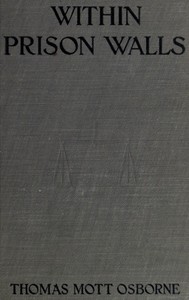
Within Prison Walls being a narrative during a week of voluntary confinement in the state prison at Auburn, New York — Background and Themes can be approached with a clearer sense of reading commitment from its source measurements: 84,085 words, 6 hr 6 min estimated reading time, and 8 detected text sections.
The text analysis averages about 20.2 words per sentence, while the detected sections provide another way to judge how the source is divided.
Project Gutenberg metadata also associates the work with “Auburn Prison,” connecting these edition facts with the source record’s subject description.
Explore this collection
These alternatives are selected using recorded categories and estimated reading time.
About 369 minutes
Fantasy Juvenile Worlds
84,842 recorded words. 3 minutes difference from this book's estimate.
View Gutenberg source #67353About 356 minutes
Fantasy Juvenile Worlds
81,823 recorded words. 10 minutes difference from this book's estimate.
View Gutenberg source #7300About 314 minutes
Fantasy Juvenile Worlds
72,186 recorded words. 52 minutes difference from this book's estimate.
View Gutenberg source #52937Search stored excerpts and compare books → Choose by your preferences →
Choices use stored catalog measurements. Estimates vary with reading speed. A shared category is a catalog label, not a claim that two books have the same argument or literary quality.
Search reads excerpt text stored with this catalog and links to its associated Gutenberg record. The connection is stored in the site database; this tool does not recheck that every excerpt is word-for-word identical to that external record. Excerpt search does not cover every chapter and does not verify historical publication dates.
Catalog snapshot checked: 2026-09-26. Coverage: 99 public books, 99 available source excerpts.
Calculated from edition completeness, EPUB availability, text structure and catalogue metadata. Not a user rating.
Total of 100 points, scaled to a 2.5-5.0 range. Editions with an empty description or a missing EPUB file are not scored.
Public-domain source text
The source text is kept in the dedicated reader, separate from this catalogue record and its commentary.
Thomas Mott Osborne entered Auburn Prison not as a warden or inspector but as inmate No. 33,333X, adopting the alias Thomas Brown for a week-long voluntary confinement. His narrative, structured as a daily journal, records the sensory shock of lockstep, striped uniforms, and shaven heads that had haunted him since a childhood tour. Yet the book quickly moves beyond personal impression to become a detailed record of conversations with prisoners—men he calls by first names like Jack and Harley—about the mechanics of prison life and the possibility of reform.
Osborne's account is notable for its specific, procedural focus: the cost of meals, the layout of cells, the rhythms of work in the machine shop. He does not merely observe; he tests ideas, particularly the concept of a Good Conduct League where inmates elect their own officers. The excerpts show him debating the plan with Jack, who warns against replicating the hated Elmira system of appointed inmate informants. This tension between top-down control and genuine self-governance becomes the book's central intellectual thread.
Osborne opens with a vivid childhood memory: the "dark, scowling faces" and "hideous striped clothing" of Auburn prisoners, which spawned nightmares of an escaped convict chasing him through dark streets. This personal history frames his return to the prison as an adult reformer. The contrast between the terrified boy and the deliberate investigator is sharp. Where the child saw only menace, the adult seeks to understand the system's logic and its human cost.
His early avoidance of the prison—refusing to join friends on tours—gives way to a methodical curiosity. The Junior Republic's success with "wild and mischievous boys" becomes his reference point, suggesting that discipline through responsibility might work for adult prisoners too. The excerpts show him moving from abstract sympathy to concrete engagement: he asks about work quotas, the quality of food, and the morale of men who labor for a cent and a half per day.
A central section of the excerpts records Osborne's extended conversation with Jack, a prisoner, about forming a Good Conduct League. The dialogue is remarkable for its practical detail and mutual respect. Jack insists that most prisoners want to behave; the problem is the "miserable degenerates" who spoil it for others. Osborne presses on the mechanism of discipline: could convict officers work? Jack rejects the Elmira model, where inmate officers are appointed by authorities and become "stool-pigeons."
Osborne then proposes that League members elect their own officers, making them representatives accountable to the men. Jack's enthusiastic response—"That's it, that's it"—marks a turning point. The discussion expands to include Sunday entertainments, athletic sports, and a governing body. Jack even imagines that if a fight broke out, the men themselves would stop it. This exchange reveals Osborne's method: he does not lecture but collaborates, testing reform ideas against the lived experience of prisoners.
Beyond the reform dialogue, Osborne's narrative is anchored in the material realities of prison life. He notes the "farcical" financial return of prison labor at a cent and a half per day, and his surprise that the state gets work as good as it does. He observes men doing their tasks "faithfully and well" with no incentive beyond "the satisfaction of work well done." These observations ground the book in economic and psychological specifics.
The excerpts also show Osborne's attention to the physical environment: the gray stone walls, the lockstep, the close-cropped heads. He does not romanticize or sensationalize; instead, he records the mundane details that shape a prisoner's day. This accumulation of concrete evidence gives weight to his reform proposals. The reader sees not an abstract system but a place where men eat, work, and talk—and where change must begin from that ground-level reality.
Osborne's account is best read as a document of applied reform thinking, not a memoir of suffering. He enters prison voluntarily and leaves after a week; his perspective remains that of an outsider who has briefly crossed the line. The value of the book lies in its detailed reporting of prisoner voices and its honest grappling with the tension between authority and self-governance. Readers interested in prison reform history will find a rare firsthand record of ideas being tested in real time, with all the hesitations and second thoughts that process entails.
I found myself thinking about Osborne’s sleepless nights in that cell, how he listened to the walls for any sign of shared humanity. Later, I opened the Warren Commission (05 of 26): Hearings Vol. V (of 15) — A Closer Reading and felt the same odd intimacy—men giving testimony, their voices flattened into transcript, yet each pause carrying its own weight.
Create a short personal record of your experience with this book.