About 107 minutes
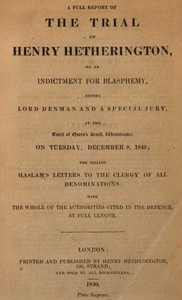
The Trial of Henry Hetherington, on an Indictment for Blasphemy — A Reader’s Guide
Fantasy Juvenile Worlds
24,567 recorded words. 32 minutes difference from this book's estimate.
View Gutenberg source #39055
This digital edition of How Justice Grew: Virginia Counties, An Abstract of Their Formation — Reading Companion is described by source-level measurements including 31,808 words, 2 hr 19 min estimated reading time, and 9 detected text sections.
The text analysis averages about 26.7 words per sentence, while the detected sections provide another way to judge how the source is divided.
Project Gutenberg metadata also associates the work with “Virginia -- History,” connecting these edition facts with the source record’s subject description.
Explore this collection
These alternatives are selected using recorded categories and estimated reading time.
About 107 minutes
Fantasy Juvenile Worlds
24,567 recorded words. 32 minutes difference from this book's estimate.
View Gutenberg source #39055About 190 minutes
Fantasy Juvenile Worlds
43,647 recorded words. 51 minutes difference from this book's estimate.
View Gutenberg source #57021About 81 minutes
Fantasy Juvenile Worlds
18,573 recorded words. 58 minutes difference from this book's estimate.
View Gutenberg source #23476Search stored excerpts and compare books → Choose by your preferences →
Choices use stored catalog measurements. Estimates vary with reading speed. A shared category is a catalog label, not a claim that two books have the same argument or literary quality.
Search reads excerpt text stored with this catalog and links to its associated Gutenberg record. The connection is stored in the site database; this tool does not recheck that every excerpt is word-for-word identical to that external record. Excerpt search does not cover every chapter and does not verify historical publication dates.
Catalog snapshot checked: 2026-09-26. Coverage: 99 public books, 99 available source excerpts.
Calculated from edition completeness, EPUB availability, text structure and catalogue metadata. Not a user rating.
Total of 100 points, scaled to a 2.5-5.0 range. Editions with an empty description or a missing EPUB file are not scored.
Public-domain source text
The source text is kept in the dedicated reader, separate from this catalogue record and its commentary.
Martha W. Hiden opens How Justice Grew not with a definition of justice but with a cargo: the English laws, customs, and religion carried aboard the Susan Constant, Godspeed, and Discovery. This concrete image—colonists bringing an “imponderable cargo” of legal tradition—anchors the entire work. The narrative then moves swiftly to the four corporations established by Governor Samuel Argall in 1617 and the first General Assembly of 1619, which Hiden notes was the model for all subsequent British colonial assemblies. The excerpts show a methodical, evidence-based approach: Hiden draws on the Journals of the House of Burgesses to trace how early settlements were grouped under corporations, and she highlights the Eastern Shore as a separate entity. This opening establishes that the book is less a narrative history than an abstract of administrative evolution, grounded in primary sources.
The earliest excerpts reveal a gradual shift from the four corporations—James City, Charles City, Henrico, and Kikotan (later Elizabeth City)—to a county system. Hiden emphasizes that the 1619 Assembly arranged burgesses by “cities and plantations,” while the 1623/24 journal grouped them under corporations for the first and only time. This detail signals her attention to administrative change. She notes that the Eastern Shore remained a separate entity, a pattern that recurs throughout the book. The language is precise: “incorporations and parishes” are treated as overlapping units, reflecting the fusion of civil and ecclesiastical boundaries in early Virginia. Readers should watch for how Hiden uses parish lines as a consistent reference point, as seen later in the division of Amherst County along parish boundaries in 1808.
A striking feature of the later excerpts is the inclusion of full boundary descriptions from legislative acts. The creation of Giles County in 1806 is described with a metes-and-bounds recitation that begins “Beginning at the end of Gauley mountain on New River” and winds through creeks, mountain tops, and straight lines to the mouth of Guyandotte River. Similarly, Scott County’s 1814 bounds run “from the head of Reedy creek where the wagon road crosses the same” to the Kentucky line. These passages are not decorative; they are the raw material of the book’s argument that county formation was a legal and geographical process. Hiden treats each boundary as a primary source, letting the language of the original acts speak for itself. The reader gains a sense of how surveyors and legislators thought in terms of natural landmarks and plantation boundaries.
Hiden observes that Virginia “has believed in honoring the men who have held the gubernatorial office,” noting that nineteen governors have been commemorated in county names. She provides examples: William H. Cabell (Cabell County, 1809), William B. Giles (Giles County, 1806), and Thomas Nelson (Nelson County, 1808). The excerpts also mention General Winfield Scott, for whom Scott County was named in 1814, and note that George Mason, Thomas Jefferson, and the Marquis de Lafayette are absent from the list. This pattern of naming is presented without commentary, but the reader can infer that the choice of honorees reflects political priorities of each era. Hiden also notes when counties later fell into West Virginia, as with Cabell and Giles, adding a layer of geopolitical change to the naming tradition.
Throughout the excerpts, rivers, mountains, and creeks serve as the primary markers of county boundaries. The Giles County description relies on New River, Gauley mountain, Wolf creek mountain, and Flat-top mountain; Scott County uses Clinch River, Powell’s mountain, and Cumberland mountain. Hiden also includes a brief aside about Mountain Lake in Giles County, noting its use as a summer resort and a field station for the University of Virginia’s Biology Department. This detail, while seemingly tangential, underscores how the same natural features that defined political boundaries later became sites of scientific and recreational interest. The reader should note that Hiden’s method is cumulative: each county entry builds on previous ones, and the repeated use of landscape language creates a consistent geographical vocabulary.
Hiden’s work is best read as a reference abstract rather than a continuous narrative. The excerpts suggest that each county entry follows a pattern: date of formation, parent counties, boundary description, and naming rationale. Readers interested in a particular county can jump to its entry, but the book rewards sequential reading by showing how boundaries shifted and names recurred. The lack of a conclusion in the excerpts leaves the story open-ended, reflecting the ongoing evolution of Virginia’s counties. Approach the text with a map at hand, and let the boundary descriptions guide your understanding of how justice—as administrative order—grew across the landscape.
Sometimes I think about how boundaries get drawn—on maps, between counties, even inside ourselves. That old Virginia booklet traced lines through legislative records, yet felt oddly human. It reminded me of Within Prison Walls being a narrative during a week of voluntary confinement in the state prison at Auburn, New York — Background and Themes, where walls become surprisingly tender. Both lingered with me as quiet meditations on enclosure and what remains visible.
Capture what you thought, learned, and would like to remember.