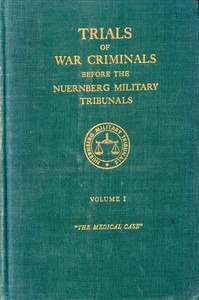
The volume opens with a preface that frames the trials as a major source of historical material, covering events from 1933 to 1945. The defendants include diplomats, military leaders, SS officers, industrialists, and professionals. The judicial machinery was part of the American occupation administration, and proceedings were recorded in full by stenographic notes and electrical sound recording, exceeding 330,000 pages.
The excerpted testimony centers on a doctor questioned about seawater experiments he conducted on himself and others. The cross-examination probes the purpose, conditions, and documentation of the experiments, highlighting the tribunal's scrutiny of subjective suffering and scientific rigor.
The Preface as a Historical Frame
The preface, written in April 1949, explicitly states that the trials are of interest to soldiers, historians, and students of international affairs. It lists prominent defendants by name and role, from State Secretary von Weizsaecker to Field Marshal von Leeb, and notes the extraordinary amount of official contemporaneous German documents introduced as evidence. This framing positions the volume not merely as a legal record but as a historical archive. The preface also details the procedural basis: Allied Control Council Law No. 10, Military Government Ordinance No. 7, and the role of OMGUS. Readers should note that the preface does not summarize the trials' outcomes but instead emphasizes the scale—over 1,200 court days and 330,000 transcript pages—and the dual-language proceedings.
Cross-Examination and the Question of Suffering
The excerpted testimony reveals a cross-examination focused on a doctor's seawater experiments. The questioning repeatedly presses on the duration of the experiment—whether subjects endured five days of deprivation or four—and the doctor's inability to confirm exact hours under oath. The interrogator challenges the doctor's claim that the experiment aimed to determine if the procedures were cruel or inhumane, asking whether he knew the degree of suffering beforehand. The doctor admits he assumed subjects would be thirsty but wanted to observe subjective sensations. This exchange illustrates the tribunal's method of testing witness credibility through precise, sometimes skeptical, questioning about experimental conditions, including diet (1,600 calories), confinement, and record-keeping.
Evidentiary Gaps and Witness Memory
The cross-examination exposes gaps in the doctor's memory and documentation. When asked about the subjects' daily activities, the doctor states they left the room for work but cannot swear they did not go to a local cinema. He recalls that a record of the experiments exists but cannot provide details from memory. The interrogator highlights the absence of a clear written record, asking, 'Have we any record on these experiments?' The doctor responds that there was a record but cannot specify its contents. This exchange underscores the trial's reliance on documentary evidence and the challenges of oral testimony. The doctor's own experiment on himself is mentioned but not described in detail, leaving the reader to infer the ethical and methodological issues at stake.
The Role of Self-Experimentation in Testimony
The doctor testifies that his judgment was influenced both by experiments conducted by a colleague, Beiglboeck, and by his own self-experiment. Beiglboeck had carried out a seawater experiment on himself before the main trials. The doctor states he wanted to know whether the experiments caused 'a pretty strong sense of discomfort, namely, thirst' without damaging health. The interrogator questions whether the doctor's testimony is based solely on his own experiments, and the doctor clarifies it is based on both. This exchange highlights the unusual position of a witness who has subjected himself to the same conditions as the subjects. The reader is left to consider how self-experimentation might affect credibility and the interpretation of suffering.
Readers approaching this volume should treat the preface as a guide to the legal and historical context, while the testimony excerpts demonstrate the adversarial process that shaped the record. The cross-examination style—persistent, detail-oriented, and occasionally skeptical—characterizes the tribunal's approach to evidence. Pay attention to how witnesses respond to challenges about memory and documentation, as these moments reveal the tensions between personal testimony and written records.
I keep thinking about those Nuremberg transcripts, how ordinary documents became unbearable evidence. It made me wonder what else hides inside old paperwork, quiet and unexamined. I stumbled on Oaths of Allegiance in Colonial New England — Story, Setting & Ideas that way. It lingers differently—less horror, more ache. The weight of a signature, a promise sworn under uncertain skies. That stayed with me. Some books sit in your chest like that.