About 211 minutes
Studies in Moro History, Law, and Religion — Reading Notes
Fantasy Juvenile Worlds
48,528 recorded words. 21 minutes difference from this book's estimate.
View Gutenberg source #41770
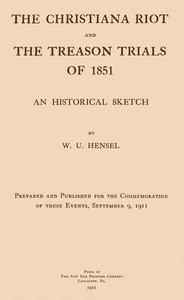
The Christiana Riot and the Treason Trials of 1851: An Historical Sketch — Reading Companion can be approached with a clearer sense of reading commitment from its source measurements: 43,647 words, 3 hr 10 min estimated reading time, and 17 detected text sections.
The text analysis averages about 19.8 words per sentence, while the detected sections provide another way to judge how the source is divided.
Project Gutenberg metadata also associates the work with “Riots -- Pennsylvania -- Christiana,” connecting these edition facts with the source record’s subject description.
Explore this collection
These alternatives are selected using recorded categories and estimated reading time.
About 211 minutes
Fantasy Juvenile Worlds
48,528 recorded words. 21 minutes difference from this book's estimate.
View Gutenberg source #41770About 215 minutes
Fantasy Juvenile Worlds
49,416 recorded words. 25 minutes difference from this book's estimate.
View Gutenberg source #12288About 139 minutes
Fantasy Juvenile Worlds
31,808 recorded words. 51 minutes difference from this book's estimate.
View Gutenberg source #39148Search stored excerpts and compare books → Choose by your preferences →
Choices use stored catalog measurements. Estimates vary with reading speed. A shared category is a catalog label, not a claim that two books have the same argument or literary quality.
Search reads excerpt text stored with this catalog and links to its associated Gutenberg record. The connection is stored in the site database; this tool does not recheck that every excerpt is word-for-word identical to that external record. Excerpt search does not cover every chapter and does not verify historical publication dates.
Catalog snapshot checked: 2026-09-26. Coverage: 99 public books, 99 available source excerpts.
Calculated from edition completeness, EPUB availability, text structure and catalogue metadata. Not a user rating.
Total of 100 points, scaled to a 2.5-5.0 range. Editions with an empty description or a missing EPUB file are not scored.
Public-domain source text
The source text is kept in the dedicated reader, separate from this catalogue record and its commentary.
The Christiana Riot and the Treason Trials of 1851: An Historical Sketch opens with a preface that situates the work as a local history, born from the author's long familiarity with the events. W. U. Hensel, born near the site, describes the conflict as "a miniature of the great struggle of opposing ideas that culminated in the shock of Civil War." The narrative then moves from a detailed account of the riot itself—where Deputy Kline's testimony is central—to the courtroom, where the prosecution defines treason as "an armed and organized resistance to the execution of the laws of Congress." The structure alternates between these two arenas, with recurring images of horses, weapons, and legal documents bridging the physical and judicial confrontations.
The book's organization reflects a deliberate movement between two distinct settings: the rural landscape of Christiana and the formal space of the federal courtroom. The riot is described through witness testimony, particularly Deputy Kline's account of Hanway sitting on his horse during the affray, while Joshua Gorsuch sought protection behind the same horse. This image recurs when the narrative shifts to the trial, where Kline becomes "the special target of severe and sarcastic cross-examination by Mr. Stevens." The author juxtaposes the chaos of the riot with the procedural order of jury selection, listing 116 potential jurors with their occupations and ages, then narrowing to the final twelve. This structural duality emphasizes how the same events are reframed through legal lenses.
Throughout the sketch, certain images reappear to connect the physical and legal conflicts. Horses feature prominently: Hanway remains mounted during the riot, and Gorsuch hides behind the horse for protection. In the courtroom, these equine images are replaced by legal documents—writs, jury lists, and indictments. Weapons also recur: the riot involves firearms, while the trial features verbal weapons like cross-examination. The author notes that the prosecution relied on proof of "armed and organized resistance," linking the physical arms of the riot to the legal arms of the state. These repeated motifs create a cohesive visual language that ties the two halves of the narrative together.
The narrative moves fluidly between direct testimony and the author's commentary. In the riot section, Deputy Kline's story is told "substantially as the incident has been related," with the author adding that Kline insisted Hanway and Lewis refused to aid him. In the trial section, the author describes the prosecution's opening and the cross-examination tactics, noting that Mr. Stevens "insisted on the Court allowing the presence in Court of all the prisoners" for a dramatic purpose. This movement between reported speech and analytical observation allows the reader to see both the raw events and their interpretation. The author's voice remains present but restrained, often framing testimony with phrases like "he insisted" or "the scene was located."
The detailed jury list serves as a structural device that mirrors the social divisions of the era. The final twelve jurors include farmers, a carpenter, a surveyor, a smith, and merchants, with an average age of 53. Their origins span multiple counties, from Perry to Philadelphia, reflecting the geographic scope of the trial. The author notes that some potential jurors were excused due to "epidemic of deafness" or because they "thought the offense treason." This cataloging of names and occupations transforms the jury into a microcosm of the broader societal conflict, where individual biases and regional loyalties intersect with the legal process. The list itself becomes a recurring image of the attempt to find impartiality amid partisan strife.
Readers should attend to how Hensel weaves the riot and trial together through repeated images and structural parallels. The sketch does not offer a single narrative but rather a layered account where testimony and commentary alternate. Pay particular attention to the jury list and the cross-examination scenes, as they reveal the tensions between law and liberty that the author identifies as central. This work is best approached as a document of how a local historian attempted to capture a pivotal moment through careful arrangement of evidence and voice.
There’s something tender about old courtroom sketches—the way a riot’s clamor settles into a judge’s quiet questions. I found myself thinking of that hush while rereading Six Years in the Prisons of England — Context and Discussion. Both books share a strange intimacy with confinement, how freedom gets measured in small, aching intervals. It lingers, that feeling, like dust on a windowsill.
Build a private reading journal entry for this title.