About 136 minutes
Concerning Justice — Key Ideas to Explore
Adventure Picaresque Fiction
31,129 recorded words. 1 minutes difference from this book's estimate.
View Gutenberg source #31504
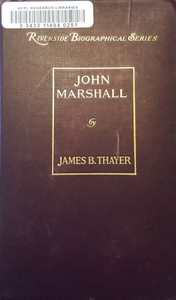
John Marshall — Reading Notes can be approached with a clearer sense of reading commitment from its source measurements: 31,388 words, 2 hr 17 min estimated reading time, and 4 detected text sections.
The text analysis averages about 25.3 words per sentence, while the detected sections provide another way to judge how the source is divided.
Project Gutenberg metadata also associates the work with “Marshall, John, 1755-1835,” connecting these edition facts with the source record’s subject description.
Explore this collection
These alternatives are selected using recorded categories and estimated reading time.
About 136 minutes
Adventure Picaresque Fiction
31,129 recorded words. 1 minutes difference from this book's estimate.
View Gutenberg source #31504About 147 minutes
Adventure Picaresque Fiction
33,809 recorded words. 10 minutes difference from this book's estimate.
View Gutenberg source #252About 149 minutes
Adventure Picaresque Fiction
34,075 recorded words. 12 minutes difference from this book's estimate.
View Gutenberg source #75420Search stored excerpts and compare books → Choose by your preferences →
Choices use stored catalog measurements. Estimates vary with reading speed. A shared category is a catalog label, not a claim that two books have the same argument or literary quality.
Search reads excerpt text stored with this catalog and links to its associated Gutenberg record. The connection is stored in the site database; this tool does not recheck that every excerpt is word-for-word identical to that external record. Excerpt search does not cover every chapter and does not verify historical publication dates.
Catalog snapshot checked: 2026-09-26. Coverage: 99 public books, 99 available source excerpts.
Calculated from edition completeness, EPUB availability, text structure and catalogue metadata. Not a user rating.
Total of 100 points, scaled to a 2.5-5.0 range. Editions with an empty description or a missing EPUB file are not scored.
Public-domain source text
The source text is kept in the dedicated reader, separate from this catalogue record and its commentary.
James Bradley Thayer's biography of John Marshall opens not with the Chief Justice himself, but with a quotation from Marshall's own Life of Washington, describing Washington's early surveying work. This indirect beginning immediately establishes a pattern: Thayer often lets Marshall's own words or the words of contemporaries frame the narrative. The biography moves fluidly between personal history—Marshall's childhood in a frontier county “agitated with the dreadful rumors” of Indian wars—and dense legal analysis of cases like Marbury v. Madison and Dartmouth College v. Woodward. Thayer's structure mirrors the dual nature of his subject: a man shaped by the Virginia frontier who later defined American constitutional law.
Thayer devotes the first chapter to Marshall's early life, emphasizing the frontier setting. He notes that Marshall's father, Thomas, was a schoolmate of Washington and served as a surveyor of the Fairfax estates, an experience that “contributed greatly to the increase of his private fortune.” The biography repeatedly links the physical landscape of Virginia to the formation of character. Marshall's birthplace, Germantown (later Midland), is described as a “little settlement” on the Southern Railroad, and his childhood household was “agitated with the dreadful rumors, anxieties, and terrors of the troubles with the French and Indians.” This concrete detail grounds the narrative in a specific time and place, avoiding abstract praise.
Thayer's treatment of Marshall's legal opinions is structured around three classes of cases: those involving the contract clause, those dealing with federal power, and those concerning the fundamental theory of constitutional law. In Marbury v. Madison, Thayer notes that the argument occupies only “about a quarter of the opinion,” yet it is the case's “chief importance.” He traces Marshall's reasoning through “principles long and well established,” including the idea that an unconstitutional act is “not law.” Thayer does not simply summarize; he shows how Marshall's logic builds step by step, from the people's intent in creating a written constitution to the court's duty to disregard void acts.
Throughout the biography, Thayer returns to images of boundaries and limits. He quotes a judge who wrote that under the Dartmouth College doctrine, the state “was stripped … of prerogatives that are commonly regarded as inseparable from sovereignty, and might have stood, like Lear, destitute before her offspring.” The metaphor of stripping and destitution recurs in discussions of taxation exemptions, which are “not to be extended beyond the exact and express language used, construed strictissimi juris.” These images reinforce the tension between governmental power and individual rights that Marshall's opinions navigated.
Thayer shifts abruptly from Marshall's personal letters to his constitutional opinions, a movement that mirrors the Chief Justice's own life. In one chapter, we see Marshall as a neighbor and citizen; in the next, we are deep in the reasoning of Ogden v. Saunders. Thayer does not smooth these transitions, allowing the reader to experience the juxtaposition of the private man and the public jurist. The biography's structure thus reflects its subject: a figure who moved from the Virginia frontier to the highest court, carrying with him the habits of a surveyor—measuring, dividing, and defining the boundaries of American law.
Thayer's biography rewards readers who attend to its structure as much as its content. The movement between personal anecdote and legal analysis is not arbitrary; it mirrors the way Marshall himself integrated experience and principle. Readers may find it useful to note how Thayer uses quotations from Marshall's own writings to frame chapters, and how the frontier imagery of the early pages echoes in the later discussions of constitutional limits. This is a work that asks to be read not as a simple narrative, but as a carefully constructed portrait of a mind.
Years of shelving have taught me how legal minds build from scattered fragments. The Marshall biography weaves frontier grit through constitutional reasoning, much as this Warren Commission (13 of 26): Hearings Vol. XIII (of 15) — A Reader’s Guide holds testimony’s raw edges against formal inquiry. Both whisper the same truth—that judgment is a patient patchwork. I often find them resting together, companions in quiet labor.
Save your reaction, strongest insight, and memorable passage.