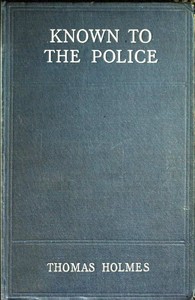
Thomas Holmes opens Known to the Police not with a crime but with a dedication to his wife, whose “gentleness has softened me” and “faith has inspired me.” This personal note sets the tone for a book that is as much about the author’s own moral formation as about the offenders he encounters. Holmes, secretary to the Howard Association, writes from twenty-five years of “sad, and often wearying, experience” in London’s “great under-world.” His preface insists that “the heart of humanity is sound and true,” a conviction that shapes every subsequent account of theft, violence, and neglect.
A Voice of Earnest Advocacy
Holmes’s prose is consistently plain, direct, and unadorned. He does not reach for literary effect; instead, he builds authority through accumulated detail and a tone of weary certainty. In the preface he writes, “I have felt the pulse of humanity, and I know that it throbs with true sympathy.” The repetition of “I know” and “I have” establishes him as a witness rather than a theorist. His sentences are often short and declarative: “The poor have no ill-feeling toward the rich; they harbour no suspicions; no envy, hatred, or malice dwell in their simple minds.” This simplicity can feel reductive, but it also conveys the moral clarity he brings to his work. He addresses the reader directly, using “you” and “we,” as if drawing them into a shared project of reform.
The Murderess as Case Study
One of the most extended excerpts concerns a governess who murders her own child to spend a weekend with a younger man. Holmes presents the facts with clinical precision: the brick carried in a reticule, the missed train, the return ticket to Dalston. But his interest lies in the woman’s “mental conditions.” He notes that she was “clever and exceedingly well educated,” with a “hard, strong cast of face,” and that she showed “no emotion, no anxiety, no feeling” throughout the proceedings. His analysis is restrained: he observes that an illegitimate child born to a woman of her age and standing signals “an absolute departure from the normal.” He does not moralize at length, but lets the incongruity between her cultivated appearance and her coldness speak for itself. The passage exemplifies his method—forensic observation followed by a single, pointed inference.
The Texture of London’s Under-World
Though the excerpts are limited, they hint at the book’s broader geography: police courts, prisons, a Home of Rest at Walton-on-the-Naze. Holmes’s London is a city of platforms, lavatories, and ticket-barriers—spaces where crimes are planned and discovered. He mentions “Broad Street Station,” “Dalston,” “London Bridge,” grounding his narratives in specific, unglamorous locales. The murderess’s brick is taken “from the garden of the house where she lived,” a detail that makes the crime feel both premeditated and domestic. Holmes’s world is one of reticules and return tickets, of small objects that become evidence. This attention to the material circumstances of poverty and crime gives his accounts a documentary weight, even when the psychology remains opaque.
The Rhetoric of Reform
Holmes is explicit about his purpose: to “bind rich and poor still closer.” His preface argues that the rich are “not unmindful of the poor” and that the poor harbour “no envy, hatred, or malice.” This optimistic framing sits uneasily alongside the brutal case he later recounts. He acknowledges the contradiction only implicitly, by insisting that such horrors are not the whole story. His language of “heart-beats” and “pulse” is deliberately organic, suggesting a social body that can be healed. The book’s dedication—to the woman who “has shared my life”—reinforces this domestic ideal. Holmes positions himself as a mediator, someone who has seen the worst and still believes in “humanity’s ultimate good.” The reader is invited to share that hope, even as the evidence accumulates against it.
Narrative Gaps and Silences
The excerpts break off before we learn the outcome of the governess’s trial, though Holmes later notes she was “found guilty, sentenced, and hanged.” He does not describe the execution. His focus remains on her “bearing and demeanour” in court, which he compares to solving a geometry problem: “Euclid over again, with quod erat faciendum.” This intellectual detachment is striking. Holmes does not express horror or pity; he simply records. The gaps in his narrative—what the young man thought, what happened to the nurse—are left unfilled. This selectivity is a deliberate authorial choice, directing attention away from sensational details and toward the moral and social questions he wants to raise. The reader must infer the emotional weight from what is omitted.
Holmes’s book is best approached as a document of its time—a reformer’s testimony shaped by the conventions of Edwardian philanthropy. Readers should attend to what he chooses to include and what he leaves out, to the tension between his hopeful rhetoric and the grim facts he presents. His plain style and first-hand authority make Known to the Police a valuable, if partial, record of how one man tried to make sense of London’s criminal poor.
I finished Known to the Police last week, and it stayed with me—not for the grimness, but for how gently Holmes watches people without judging them. It made me think of something quieter, a different kind of patience in John Marshall — Reading Notes, where the margins hold their own small truths. Both felt like sitting beside someone who notices rather than explains.