About 286 minutes
The Caillaux Drama — Themes and Context
Adventure Picaresque Fiction
65,625 recorded words. 19 minutes difference from this book's estimate.
View Gutenberg source #52680
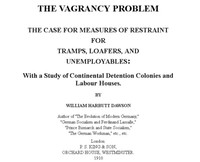
The Vagrancy Problem. The Case for Measures of Restraint for Tramps, Loafers, and Unemployables: With a Study of Continental Detention Colonies and Labour Houses — Background and Themes can be approached with a clearer sense of reading commitment from its source measurements: 69,971 words, 5 hr 5 min estimated reading time, and 9 detected text sections.
The text analysis averages about 26.7 words per sentence, while the detected sections provide another way to judge how the source is divided.
Project Gutenberg metadata also associates the work with “Tramps,” connecting these edition facts with the source record’s subject description.
Explore this collection
These alternatives are selected using recorded categories and estimated reading time.
About 286 minutes
Adventure Picaresque Fiction
65,625 recorded words. 19 minutes difference from this book's estimate.
View Gutenberg source #52680About 333 minutes
Adventure Picaresque Fiction
76,500 recorded words. 28 minutes difference from this book's estimate.
View Gutenberg source #55847About 253 minutes
Adventure Picaresque Fiction
57,989 recorded words. 52 minutes difference from this book's estimate.
View Gutenberg source #41075Search stored excerpts and compare books → Choose by your preferences →
Choices use stored catalog measurements. Estimates vary with reading speed. A shared category is a catalog label, not a claim that two books have the same argument or literary quality.
Search reads excerpt text stored with this catalog and links to its associated Gutenberg record. The connection is stored in the site database; this tool does not recheck that every excerpt is word-for-word identical to that external record. Excerpt search does not cover every chapter and does not verify historical publication dates.
Catalog snapshot checked: 2026-09-26. Coverage: 99 public books, 99 available source excerpts.
Calculated from edition completeness, EPUB availability, text structure and catalogue metadata. Not a user rating.
Total of 100 points, scaled to a 2.5-5.0 range. Editions with an empty description or a missing EPUB file are not scored.
Public-domain source text
The source text is kept in the dedicated reader, separate from this catalogue record and its commentary.
William Harbutt Dawson opens The Vagrancy Problem with a Thomas Carlyle epigraph that declares 'for the idle man there is no place in this England of ours,' immediately establishing a moralistic tone. The book, published in 1910, is a policy argument rather than a sociological survey: it advocates for 'measures of restraint' against tramps, loafers, and the unemployable, drawing heavily on continental models. Dawson’s prose is administrative and precise, filled with tables of inmate numbers, work outputs, and legal codes. The author, a noted scholar of German social policy, treats vagrancy as a problem of discipline and productivity, not poverty or charity.
Dawson’s choice of epigraph from Carlyle’s Chartism is not decorative; it frames the entire work. Carlyle’s lines—'He that will not work according to his faculty, let him perish according to his necessity'—are quoted at length, and Dawson returns to this logic throughout. The epigraph also includes a counter-quote: 'All evil, and this evil too, is a nightmare, the instant you begin to stir under it, the evil is, properly speaking, gone.' This tension between harsh judgment and reformist action runs through the book. Dawson does not merely condemn vagrants; he proposes institutional solutions. Yet the Carlyle excerpt reveals a foundational assumption: that idleness is a moral failing requiring state correction, not economic relief.
Dawson’s vocabulary is relentlessly taxonomic. He speaks of 'tramps, loafers, and unemployables' as distinct categories, and his chapters separate 'the urban loafer' from 'the German tramp prisons.' The subtitle itself—'The Case for Measures of Restraint'—uses legal and penal diction. In the introduction, he describes English public opinion as 'moving but maturing,' implying a progressive evolution toward harsher policies. The text is peppered with official phrases: 'correctional prisoners,' 'way tickets,' 'labour houses.' This bureaucratic register reflects Dawson’s reliance on government reports and continental legislation. He reproduces the Belgian Law of November 27, 1891, for the Repression of Vagrancy and Beggary verbatim in an appendix, treating legal text as evidence.
Numbers dominate the excerpts. Dawson includes tables of inmates in Prussian labour houses, breaking down 'agricultural' versus 'industrial' work: 704 agricultural outside persons versus 1,737 industrial. He cites an official statement on prisoner employment, listing reclamation projects: '3,000 hectares (7,410 acres) in extent' of moorland cultivated, 'seventeen settlers' established. These figures serve a persuasive function, demonstrating that continental systems are productive and orderly. Dawson does not question the data’s provenance or the conditions of forced labour; he presents statistics as neutral proof. The effect is to make vagrancy seem a technical problem solvable by administrative efficiency, not a human crisis.
Dawson devotes five chapters to European institutions: Belgian beggars’ depots, German labour houses, German tramp prisons, the Berlin municipal labour house, and Swiss treatment of vagrancy. The excerpts show him quoting Prussian regulations at length, including rules that prisoners may be used for 'agricultural improvement works' and that 'criminal and correctional prisoners may not be employed together.' He notes that prisoners show themselves 'willing, diligent, and apt' and that 'attempts at escape occur very seldom.' This portrayal is uniformly positive; Dawson does not record dissent or failure. The implicit argument is that England should adopt similar measures. The book functions as a policy brief, marshalling foreign examples to support domestic reform.
Readers should approach The Vagrancy Problem as a primary source for early twentieth-century attitudes toward poverty and labour. Dawson’s reliance on official documents and his comparative method make the book useful for studying how states constructed the category of the 'unemployable.' The text does not give voice to vagrants themselves; they appear only as objects of policy. For those interested in the history of social control, welfare, or penal labour, this work offers a detailed, if one-sided, record of the arguments that shaped detention colonies and labour houses in Europe.
Sometimes I think about Dawson’s stern tables and labour houses, and how neatly they filed away uneasy lives. It made me oddly grateful for the messier margins. That’s the feeling I kept returning to while leafing through John Marshall — Reading Notes—someone quietly jotting down thoughts without any system, just a hand and a pencil, letting the rest wander.
Build a private reading journal entry for this title.