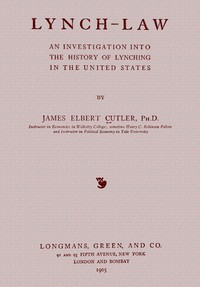
James Elbert Cutler's Lynch-law (1905) opens with a foreword by William Graham Sumner that sets a stark moral tone: "It is a disgrace to our civilization that men can be put to death by painful methods, which our laws have discarded as never suitable." The book itself is a systematic investigation, not a narrative history. Cutler, an economist and sociologist, approaches lynching as a social phenomenon to be measured and categorized. The excerpts reveal a work built on tabulated data, charts, and comparative percentages rather than anecdotal accounts. The catalog subject "Lynching -- United States" accurately describes the topic, but the excerpts show a narrower focus: the statistical breakdown of lynchings by cause and race from 1882 to 1903, with particular attention to the Southern states.
Statistical Framework and Racial Comparisons
The excerpts center on a series of charts (VI through X) that quantify lynchings by cause—Murder, Rape, Theft, Arson, Assault, Desperadism, Minor Offenses—and separate the data by race: "Whites and Others" versus "Negroes." Cutler's method is comparative: he notes that for Whites and Others, "Murder with 628 stands highest, and Theft, with 264, second," while for Negroes, "Murder is credited with 783 and Rape with 707." The text explicitly draws attention to characteristic differences: "Rape which occupies second place in the chart for the Negroes and is nearly equal to Murder, drops to third place on the chart for the Whites and Others." Similarly, Theft among Whites is largely livestock stealing ("nearly 90 per cent"), whereas for Negroes it is "petty larceny." These comparisons are the book's evidentiary core, not moral argument.
Causes and Their Shifting Importance
Cutler tracks changes over time, noting that certain causes "have increased in importance as a cause for the lynching of Negroes." The excerpts show a breakdown by year and region, with a focus on the Southern Group of States. The data reveals that "Minor Offenses" and "Arson" are more prominent causes for Negro lynchings than for Whites. The text states: "Of the Negroes lynched for Theft only 14 per cent were lynched for stealing live stock, the remaining 86 per cent being lynched for causes that may be fairly classed under petty larceny." This granularity suggests Cutler's aim was to correct popular assumptions about the reasons for mob violence. The preface indicates his purpose: "to determine from the history the causes for the prevalence of the practice." The excerpts do not reveal his conclusions, only his method.
The Foreword as Moral Frame
William Graham Sumner's foreword provides the book's ethical context without dictating its content. He writes that "few people are able to read about lynch-executions, with atrocious forms of torture and cruel death... without a feeling of national shame." Sumner distinguishes between lynching where law is absent and where it is present, arguing that "it is not admissible that a self-governing democracy should plead the remissness of its own selected agents as an excuse for mob-violence." His language is pointed: "Torture and burning are forbidden, not because the victim is not bad enough, but because we are too good." This framing positions Cutler's statistical work as a corrective to public opinion, which Sumner says "is not educated up to this level." The foreword thus sets expectations for a dispassionate, evidence-based inquiry.
Scope and Limitations of the Excerpts
The excerpts cover only the foreword, preface, and a statistical section near the end of the book. They do not include the historical chapters that presumably trace lynching's origins or the legal context. The catalog subject "philosophy-ethics" is secondary; the excerpts show no explicit philosophical argument, only Sumner's moral stance. Cutler's own voice is clinical, focused on percentages and categories. The reader should not assume that the book is solely a statistical compendium; the preface promises a historical investigation. The excerpts are insufficient to assess the book's treatment of individual cases, regional variations beyond the South, or the evolution of lynching before 1882. The work's full argument about causes remains inferred, not demonstrated.
Readers approaching Lynch-law should be prepared for a data-heavy text that prioritizes classification over narrative. The excerpts suggest that Cutler's contribution lies in his systematic tabulation of lynchings by cause and race, a method that allows for precise comparisons. The foreword by Sumner offers a moral lens, but the body of the work appears to let the numbers speak. To understand Cutler's full thesis, one must read beyond the statistical chapters into the historical analysis that frames them. This is a work of social science, not polemic, and its value lies in the rigor of its evidence.
Reading about the cold statistics of lynching, I remembered my grandfather's hushed stories of county lines drawn in fear, not geography. The same quiet gravity surfaced later in How Justice Grew: Virginia Counties, An Abstract of Their Formation — Reading Companion, where borders felt like scars on the land, each boundary a small testament to who belonged and who was left just outside. Justice, both books whispered, was always a place, rarely a promise.