About 72 minutes
Devonshire Witches — Context and Discussion
Fantasy Juvenile Worlds
16,488 recorded words. 40 minutes difference from this book's estimate.
View Gutenberg source #62273
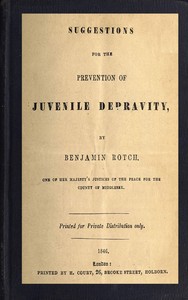
The source record for Suggestions for the Prevention of Juvenile Depravity — Themes and Context measures this digital text at 7,164 words, 32 min estimated reading time, and 3 detected text sections.
The text analysis averages about 35.1 words per sentence, while the detected sections provide another way to judge how the source is divided.
Project Gutenberg metadata also associates the work with “Juvenile delinquency -- England -- History -- 19th century -- Sources,” connecting these edition facts with the source record’s subject description.
Explore this collection
These alternatives are selected using recorded categories and estimated reading time.
About 72 minutes
Fantasy Juvenile Worlds
16,488 recorded words. 40 minutes difference from this book's estimate.
View Gutenberg source #62273About 78 minutes
Fantasy Juvenile Worlds
17,779 recorded words. 46 minutes difference from this book's estimate.
View Gutenberg source #54042About 81 minutes
Fantasy Juvenile Worlds
18,573 recorded words. 49 minutes difference from this book's estimate.
View Gutenberg source #23476Search stored excerpts and compare books → Choose by your preferences →
Choices use stored catalog measurements. Estimates vary with reading speed. A shared category is a catalog label, not a claim that two books have the same argument or literary quality.
Search reads excerpt text stored with this catalog and links to its associated Gutenberg record. The connection is stored in the site database; this tool does not recheck that every excerpt is word-for-word identical to that external record. Excerpt search does not cover every chapter and does not verify historical publication dates.
Catalog snapshot checked: 2026-09-26. Coverage: 99 public books, 99 available source excerpts.
Calculated from edition completeness, EPUB availability, text structure and catalogue metadata. Not a user rating.
Total of 100 points, scaled to a 2.5-5.0 range. Editions with an empty description or a missing EPUB file are not scored.
Public-domain source text
The source text is kept in the dedicated reader, separate from this catalogue record and its commentary.
Benjamin Rotch, a Middlesex justice of the peace, opens his 1846 pamphlet with a blunt fiscal argument: preventing juvenile crime costs less than prosecuting and imprisoning young offenders. He contrasts the expense of maintaining “innocent children” with that of “maintaining them as felons,” framing prevention as both a moral and economic imperative. Rotch’s language is direct and urgent, peppered with rhetorical questions that challenge ratepayers, juries, and ministers to act. He dismisses prison discipline as a “Panacea” that fails to address root causes, instead advocating for a system that teaches “useful Arts” to working-class children, making literacy and arithmetic “ancillary” to practical trades.
Rotch’s authorial voice is that of a seasoned magistrate speaking from “long experience in such matters.” He employs a series of escalating rhetorical questions—“How much longer will the overburthened Ratepayers endure…?”—to build pressure on his audience. The repetition of “How much longer” across four consecutive sentences creates a rhythmic insistence, mimicking the relentless cycle of crime and punishment he decries. His diction is concrete and visceral: “drunken Father,” “starving Children,” “Gin Palace,” “Beer Shop.” He avoids abstract theorizing, grounding his argument in scenes of domestic ruin and petty theft. The pamphlet’s structure mirrors a courtroom summation, with Rotch piling evidence—arrests, examinations, committals, trials—before delivering his proposed remedy.
Rotch’s most striking metaphor is the “Upas Tree,” a poisonous plant from Javanese folklore, which he uses to describe juvenile depravity spreading through densely populated neighborhoods. He writes that even “the good and virtuous” can reach its branches, “thinking they are destroying the tree by endeavouring to keep its unwieldly limbs within bounds by the pruning knife.” This image encapsulates his critique of piecemeal reforms: prison discipline, hulks, transportation—all are mere pruning. The tree’s “root” must be destroyed, and for Rotch that root is the failure to educate poor children in practical trades before they become criminals. The metaphor recurs implicitly throughout, reinforcing his central argument that prevention, not punishment, is the only effective cure.
Rotch proposes a radical shift in working-class education: instead of teaching “Reading, Writing, and Arithmetic” to a level that makes children “seek places above that which Nature destined them to fulfil,” he advocates for instruction in “useful Arts” that suit their “humble station.” Literacy and numeracy become “merely ancillary” to trades. He also suggests that employers withhold wages from “abandoned and depraved Mechanic[s]” and disburse them for “the legitimate object” of family support—a form of wage control that reflects his paternalistic view. Rotch’s language here is prescriptive and class-bound, assuming a fixed social hierarchy. Yet his proposal is pragmatic: he calculates that maintaining a child as an innocent costs less than capturing, trying, and imprisoning an adult felon, appealing directly to the ratepayer’s wallet.
Throughout the pamphlet, Rotch frames prevention as a matter of “finance” as much as morality. He poses a stark choice: “whether it would be more expensive to maintain any given number of innocent Children, and educate them as I propose… than to capture, try, and maintain an equal number of Adult Felons.” His arithmetic is deliberately simple, contrasting the “enormous cost” of the criminal justice system with the modest expense of industrial schooling. This economic argument is interwoven with Christian duty: he insists that prevention is “more consistent with the views of Christianity and common sense.” Rotch’s dual appeal—to the pocketbook and the conscience—reflects his intended audience of ratepayers, magistrates, and legislators, whom he hopes to move by both self-interest and moral obligation.
Rotch’s pamphlet is a document of its time—1846, before compulsory education or a formal juvenile justice system—but its core argument resonates beyond that context. Readers should attend to how Rotch uses rhetorical repetition, concrete imagery, and fiscal reasoning to persuade. His voice is that of a reformer who believes that systemic change, not harsher punishment, can break the cycle of poverty and crime. The excerpts leave unclear how his proposed schools would be funded or governed, but his central claim—that prevention is cheaper than punishment—remains a provocative lens for examining modern debates.
The rain kept pace with Rotch’s careful argument that a child’s labor might save them, and I found myself thinking about how fear drives punishment. Later, pulling a random volume from the shelf, I landed on The Witchcraft Delusion in Colonial Connecticut (1647-1697) — Story, Setting & Ideas, where the same impulse—to control the unknown—wore a different, older face. Both books left me staring at the window, the afternoon gone.
Answer a few questions and save a private reflection on this device.