About 486 minutes
The Reminiscences of Sir Henry Hawkins (Baron Brampton) — Edition Insights
Adventure Picaresque Fiction
111,714 recorded words. 34 minutes difference from this book's estimate.
View Gutenberg source #10392
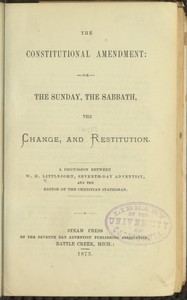
The Constitutional Amendment: or, The Sunday, the Sabbath, the Change, and Restitution A discussion between W. H. Littlejohn, Seventh-day Adventist, and the editor — Context and Discussion can be approached with a clearer sense of reading commitment from its source measurements: 103,895 words, 7 hr 32 min estimated reading time, and 37 detected text sections.
The text analysis averages about 26.6 words per sentence, while the detected sections provide another way to judge how the source is divided.
Project Gutenberg metadata also associates the work with “Sunday,” connecting these edition facts with the source record’s subject description.
Explore this collection
These alternatives are selected using recorded categories and estimated reading time.
About 486 minutes
Adventure Picaresque Fiction
111,714 recorded words. 34 minutes difference from this book's estimate.
View Gutenberg source #10392About 333 minutes
Adventure Picaresque Fiction
76,500 recorded words. 119 minutes difference from this book's estimate.
View Gutenberg source #55847About 305 minutes
Adventure Picaresque Fiction
69,971 recorded words. 147 minutes difference from this book's estimate.
View Gutenberg source #46904Search stored excerpts and compare books → Choose by your preferences →
Choices use stored catalog measurements. Estimates vary with reading speed. A shared category is a catalog label, not a claim that two books have the same argument or literary quality.
Search reads excerpt text stored with this catalog and links to its associated Gutenberg record. The connection is stored in the site database; this tool does not recheck that every excerpt is word-for-word identical to that external record. Excerpt search does not cover every chapter and does not verify historical publication dates.
Catalog snapshot checked: 2026-09-26. Coverage: 99 public books, 99 available source excerpts.
Calculated from edition completeness, EPUB availability, text structure and catalogue metadata. Not a user rating.
Total of 100 points, scaled to a 2.5-5.0 range. Editions with an empty description or a missing EPUB file are not scored.
Public-domain source text
The source text is kept in the dedicated reader, separate from this catalogue record and its commentary.
The volume opens with a preface that frames the debate as a response to a growing political movement seeking to amend the U.S. Constitution to recognize God, Christ, and the Bible as sources of national law, enforce Sunday observance, and mandate Bible reading in schools. Littlejohn, a Seventh-day Adventist, positions his arguments as a solemn protest against what he sees as a threat to religious liberty, though he disclaims partisan interest. The work collects articles previously published in three periodicals—the Christian Statesman, the Sabbath Recorder, and the Advent Review—and adds replies and rejoinders. This origin as a serialized exchange shapes the text's structure: each segment responds directly to an opponent's claims, creating a point-by-point theological and legal disputation rather than a continuous treatise.
The preface identifies the core issue: a party is organizing to amend the Constitution so that “the names of God and Christ may appear in it” and to enforce Sunday as the Christian Sabbath. Littlejohn warns that these issues will soon become the focus of fierce political conflict, with the press already recording events that add “fuel to a flame which even now burns with a fierceness and volume indicative of its future scope and power.” He presents his intervention as a Christian duty, not a partisan act. The reader should note that the preface does not summarize the debate's outcome; it only establishes the urgency and the author's stance. The excerpts that follow are drawn from the body of the discussion, where Littlejohn engages in close biblical interpretation to defend the seventh-day Sabbath and challenge Sunday observance.
In the excerpted portion, Littlejohn dissects 1 Corinthians 16:2, where Paul instructs believers to “lay by him in store” on the first day of the week. Littlejohn argues that the Greek phrase rendered “by him” is idiomatic for “at home,” and he contends that the verse does not mandate a public collection on Sunday but rather a private setting aside of funds. He writes that “the first day of the week must have offered a special facility for doing what was required,” but he insists that the money was to be brought to the weekly meeting, not that the day itself was sanctified. His reasoning is grammatical and contextual: he points to the verb “lay” (not “lay by”), the connection of “at home” with the preceding verb, and Paul's aim to avoid collections upon his arrival. This passage exemplifies Littlejohn's method: he challenges the proof-texts used by Sunday advocates by scrutinizing translation and syntax.
Littlejohn also addresses Revelation 1:10, where John says he was “in the Spirit on the Lord's day.” The excerpt breaks off before his full argument, but the context suggests he will dispute the identification of “Lord's day” with Sunday, a common Seventh-day Adventist position that the phrase refers to the seventh-day Sabbath. The reader should observe how Littlejohn handles this pivotal text: he likely argues from early Christian usage and the absence of explicit Sunday worship in the New Testament. The debate's structure—alternating between Littlejohn's articles and the editor's replies—means that each scriptural claim is met with counterarguments. The excerpts do not reveal the editor's responses, so the reader must infer the opposing case from Littlejohn's refutations. This makes the text a record of one side of a live controversy, not a settled conclusion.
Beyond exegesis, the debate engages the political question of Sunday legislation. The preface notes that the movement seeks “the enforcement by law of the observance of Sunday, as the Christian Sabbath.” Littlejohn, as a Seventh-day Adventist, likely argues that such laws violate the separation of church and state and impose a religious observance not commanded in Scripture. The excerpts do not include his political arguments, but the catalog subjects—Sunday legislation, Seventh-day Adventist doctrines—indicate that the book is both a theological treatise and a political intervention. The reader should attend to how Littlejohn weaves together biblical interpretation and constitutional reasoning. The work's origin in periodical exchanges also suggests a polemical tone: each article is a rejoinder, and the reader is placed in the position of a contemporary following a serialized dispute. The absence of a neutral narrator means that all claims are contested.
Readers approaching this debate should recognize that the excerpts represent only one participant's arguments, and the full text includes replies from the Christian Statesman editor that are not reproduced here. The work rewards attention to its exegetical details—grammatical points, idiomatic phrases, and the logic of Paul's instructions—rather than a search for narrative or character. As a primary source for nineteenth-century religious and political controversies, it offers insight into how Seventh-day Adventists framed their opposition to Sunday laws and constitutional amendments. The debate's serialized structure means that each section builds on previous claims; reading sequentially will clarify the progression of the argument.
I remember Sunday afternoons at my grandfather's house, arguing about the sabbath while the light slanted through dusty blinds. This debate felt familiar—two earnest voices, each certain. Later, reading The Debs Decision — Context and Discussion, I felt that same quiet ache: how law becomes a battleground for what we hold most sacred.
Answer a few questions and save a private reflection on this device.