About 702 minutes
A History of Matrimonial Institutions, Vol. 3 of 3 — Key Ideas to Explore
Adventure Picaresque Fiction
161,319 recorded words. 59 minutes difference from this book's estimate.
View Gutenberg source #49276
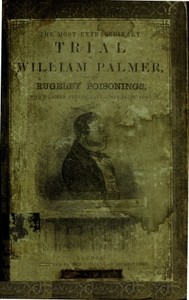
This digital edition of The Most Extraordinary Trial of William Palmer, for the Rugeley Poisonings, which lasted Twelve Days — Reading Notes is described by source-level measurements including 147,851 words, 10 hr 43 min estimated reading time, and 13 detected text sections.
The text analysis averages about 17.5 words per sentence, while the detected sections provide another way to judge how the source is divided.
Project Gutenberg metadata also associates the work with “Trials (Murder) -- England -- London,” connecting these edition facts with the source record’s subject description.
Explore this collection
These alternatives are selected using recorded categories and estimated reading time.
About 702 minutes
Adventure Picaresque Fiction
161,319 recorded words. 59 minutes difference from this book's estimate.
View Gutenberg source #49276About 486 minutes
Adventure Picaresque Fiction
111,714 recorded words. 157 minutes difference from this book's estimate.
View Gutenberg source #10392About 452 minutes
Adventure Picaresque Fiction
103,895 recorded words. 191 minutes difference from this book's estimate.
View Gutenberg source #61071Search stored excerpts and compare books → Choose by your preferences →
Choices use stored catalog measurements. Estimates vary with reading speed. A shared category is a catalog label, not a claim that two books have the same argument or literary quality.
Search reads excerpt text stored with this catalog and links to its associated Gutenberg record. The connection is stored in the site database; this tool does not recheck that every excerpt is word-for-word identical to that external record. Excerpt search does not cover every chapter and does not verify historical publication dates.
Catalog snapshot checked: 2026-09-26. Coverage: 99 public books, 99 available source excerpts.
Calculated from edition completeness, EPUB availability, text structure and catalogue metadata. Not a user rating.
Total of 100 points, scaled to a 2.5-5.0 range. Editions with an empty description or a missing EPUB file are not scored.
Public-domain source text
The source text is kept in the dedicated reader, separate from this catalogue record and its commentary.
The anonymous compiler of this trial record immediately establishes a dual structure: a biographical memoir of William Palmer precedes the twelve-day courtroom transcript. The memoir, though brief, frames Palmer not as a medical man but as a turf enthusiast who neglected his profession, setting up a tension between professional identity and personal pursuits that recurs throughout the testimony. The trial itself unfolds in a strict chronological sequence, each day marked by a heading that signals the relentless accumulation of evidence.
The memoir opens with Palmer’s medical credentials—pupil at St. Bartholomew’s, diploma in 1846—but quickly pivots to his sporting interests: he “paid more attention to the ‘turf’” than to his practice. This contrast between professional training and actual conduct becomes a leitmotif. The memoir also notes that Palmer’s name appeared in medical directories as someone who “neglected to inform the editor” of his qualifications, a small but telling detail that hints at evasion. The narrative then moves to his marriage to Anne Thornton, natural daughter of Colonel Brookes, and the inheritance of houses and rupees—a financial backdrop that foreshadows the monetary entanglements central to the trial. By beginning with Palmer’s life outside the courtroom, the compiler ensures that readers encounter the accused as a man of dubious reputation before any witness speaks.
The trial transcript is divided into twelve days, each introduced by a bold heading (e.g., “Second Day, May 15”). This structure imposes a steady, almost liturgical rhythm on the proceedings. Within each day, the text alternates between prosecution and defense arguments, witness examinations, and occasional interruptions for legal quibbles. The compiler does not editorialize; instead, the raw sequence of testimony creates its own drama. For instance, on the seventh day, the defense begins, and the heading “The Defence. (Seventh Day Continued.)” signals a shift in momentum. The reader moves through the days as a juror might, accumulating details about forged cheques, horse sales, and antimony traces. The repetition of dates and locations—Rugeley, London, Doncaster—anchors the narrative in a specific geography of crime.
Recurring images of money and horses bind the memoir and trial together. The memoir mentions Palmer’s inheritance and his wife’s property; the trial testimony dwells on cheques, bills of sale, and wine warrants. Horses—Polestar and Sirius—appear as collateral for loans, their names evoking speed and value. The prosecution’s theory hinges on Palmer forging Cook’s endorsement to intercept £375 and a wine warrant. The defense counters that Cook willingly signed documents and received cash. Throughout, the language of finance is precise: “stamp,” “endorsement,” “power of attorney.” Poison enters the record more obliquely, through medical testimony about strychnine and antimony, but the compiler never lets the reader forget that the ultimate charge is murder by poisoning. The juxtaposition of monetary greed and chemical death gives the trial its grim coherence.
On the seventh day, the defense offers an alternative reading of events. The defense counsel argues that Cook, needing ready money, authorized Palmer to cash a bill and accepted £315 in cash while Palmer kept the cheque. This version relies on a letter from Palmer to Pratt, dated September 6, requesting that the money be sent “in cash, in a registered letter” to Doncaster. The defense emphasizes that Cook’s name was written on the cheque “with his full knowledge and consent,” and that no attempt was made to imitate his handwriting. The structure of the trial allows this counter-narrative to unfold in parallel with the prosecution’s, creating a dialectic that the reader must weigh. The compiler does not resolve the conflict; instead, the transcript preserves both voices, leaving the verdict to the jury—and to history.
Readers approaching this record should attend to its layered structure: the memoir as prelude, the daily headings as markers of suspense, and the recurring motifs of finance and equine imagery. The anonymous compiler has shaped raw courtroom speech into a narrative that demands close reading. Whether one reads for historical insight or for the drama of a Victorian cause célèbre, the text rewards attention to its deliberate arrangement.
Reading the Palmer transcript, I kept noticing how money and poison braid together—every ledger entry a small verdict. It made me think of my old copy of A Selection of Cases on the Law of Torts — Context and Discussion, where harm wears a quieter face, but the same patient arithmetic of accountability runs underneath. Strange how those pages stay with you.
Your answers remain private and are stored only in this browser.