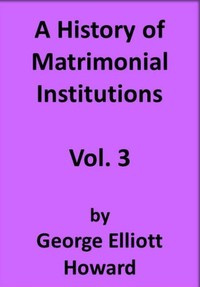
A History of Matrimonial Institutions, Vol. 3 of 3 — Key Ideas to Explore

(0 User reviews)   1785
Howard, George Elliott, 1849-1928 Project Gutenberg 2015 Not confirmed
Marriage -- History; Families Readers of public-domain and historical texts
Project Gutenberg digital edition en

Edition facts

Words 161,319
Reading time 702 min
Text sections 32

Before opening A History of Matrimonial Institutions, Vol. 3 of 3 — Key Ideas to Explore, the edition data offers a quick orientation: 161,319 words, 11 hr 42 min estimated reading time, and 32 detected text sections.

The text analysis averages about 11.8 words per sentence, while the detected sections provide another way to judge how the source is divided.

Project Gutenberg metadata also associates the work with “Marriage -- History,” connecting these edition facts with the source record’s subject description.

Explore this collection

Compare your next read

These alternatives are selected using recorded categories and estimated reading time.

Search stored excerpts and compare books → Choose by your preferences →

How these choices and excerpts are prepared

Choices use stored catalog measurements. Estimates vary with reading speed. A shared category is a catalog label, not a claim that two books have the same argument or literary quality.

Search reads excerpt text stored with this catalog and links to its associated Gutenberg record. The connection is stored in the site database; this tool does not recheck that every excerpt is word-for-word identical to that external record. Excerpt search does not cover every chapter and does not verify historical publication dates.

Catalog snapshot checked: 2026-09-26. Coverage: 99 public books, 99 available source excerpts.

This volume examines the evolution of marriage law in England and the United States, focusing on the shift from ecclesiastical to civil jurisdiction, the rise of free marriage, and the legal status of women. Drawing on extensive primary sources, Howard traces how canonical theories, Protestant reforms, and state legislation shaped modern matrimonial institutions.
Share
Editorial Edition Score 4.9/5

Calculated from edition completeness, EPUB availability, text structure and catalogue metadata. Not a user rating.

How this score is calculated
  • Description quality20 pts
  • Title & short description10 pts
  • Source metadata20 pts
  • Text length15 pts
  • Chapters / structure15 pts
  • EPUB file integrity20 pts

Total of 100 points, scaled to a 2.5-5.0 range. Editions with an empty description or a missing EPUB file are not scored.

Edition quality

Public-domain source text

Read the source text

The source text is kept in the dedicated reader, separate from this catalogue record and its commentary.

George Elliott Howard's third volume of A History of Matrimonial Institutions opens with a detailed analysis of the transition from ecclesiastical to civil control over marriage in England. The table of contents reveals a systematic structure: chapters on the rise of free marriage, the church's adoption of lay contracts, and the development of canonical law. Howard's method is evident in his use of primary sources such as parish registers and legal commentaries, grounding his arguments in specific documentary evidence rather than abstract theory.

From Ecclesiastical to Civil Jurisdiction

Howard devotes considerable attention to the shift in marriage authority from church courts to state institutions. In the English context, he examines how the Protestant Reformation challenged canonical doctrines, particularly regarding clandestine marriages and the requirement of priestly blessing. The excerpts show his reliance on statutes and court rulings, such as the Hardwicke Marriage Act of 1753, which required banns or licenses and registration. Howard notes that prior to this act, 'clandestine marriages' were common, often performed without parental consent or proper documentation. He traces the gradual assertion of state control through registration requirements and the elimination of ecclesiastical privileges.

The Legal Status of Women in Marriage

Howard's analysis of married women's legal position draws on English common law and American state statutes. He discusses the doctrine of coverture, under which a wife's legal identity was subsumed by her husband's. The excerpts reference property rights, divorce provisions, and the 'rights and liabilities of husband and wife' as debated in periodicals like the Edinburgh Review. Howard contrasts the English system with developments in the United States, where some states began enacting married women's property acts in the mid-nineteenth century. He does not offer a comprehensive assessment but presents evidence of incremental legal change.

Primary Sources and Scholarly Method

The extensive bibliography in the excerpts reveals Howard's reliance on a wide range of sources: ecclesiastical decrees, legal commentaries, parliamentary reports, and regional studies. He cites works in Latin, German, and French, indicating a comparative approach. For example, he includes references to the Corpus juris canonici, the Rituale Romanum, and German treatises on church law. Howard also draws on local parish registers, such as those from St. Chad, Saddlworth, to illustrate marriage practices. This attention to documentary evidence suggests a method grounded in empirical research rather than theoretical speculation.

Readers approaching this volume should note that it is the third part of a larger work, presupposing familiarity with earlier discussions of primitive marriage and English ecclesiastical law. Howard's focus on legal and institutional history means that social or cultural aspects of marriage are treated only insofar as they intersect with statutes and court decisions. The extensive footnotes and bibliography offer a roadmap for further research, but the text itself is dense with legal terminology and procedural detail.

I keep thinking about how Howard traces the quiet legal shifts that reshaped women’s lives—slow, almost invisible changes inside sturdy institutions. It reminded me of reading Behind the prison bars — Reading Notes, where confinement feels both literal and chosen. Both books left me sitting with the weight of unseen structures, and how we move within them, barely noticing the bars until we look back.

There are no reviews for this eBook.

0
0 out of 5 (0 User reviews )

Add a Review

Your Rating *
There are no comments for this eBook.

Reader reflection

How will you remember this book?

Save your reaction, strongest insight, and memorable passage.

Your progress 0 / 10
1

What is your current status with this title?

2

Did this book hold your interest?

3

Would you encourage someone else to read it?

4

What was the reading difficulty like?

Related eBooks