About 702 minutes
A History of Matrimonial Institutions, Vol. 3 of 3 — Key Ideas to Explore
Adventure Picaresque Fiction
161,319 recorded words. 250 minutes difference from this book's estimate.
View Gutenberg source #49276
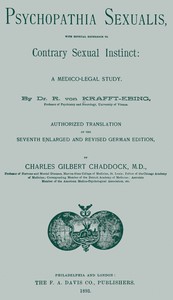
Before opening Psychopathia sexualis: With especial reference to contrary sexual instinct A medico-legal study — Context and Discussion, the edition data offers a quick orientation: 218,756 words, 15 hr 52 min estimated reading time, and 33 detected text sections.
The text analysis averages about 18.1 words per sentence, while the detected sections provide another way to judge how the source is divided.
Project Gutenberg metadata also associates the work with “Paraphilias,” connecting these edition facts with the source record’s subject description.
Explore this collection
These alternatives are selected using recorded categories and estimated reading time.
About 702 minutes
Adventure Picaresque Fiction
161,319 recorded words. 250 minutes difference from this book's estimate.
View Gutenberg source #49276About 643 minutes
Adventure Picaresque Fiction
147,851 recorded words. 309 minutes difference from this book's estimate.
View Gutenberg source #51135About 1,388 minutes
Adventure Picaresque Fiction
319,091 recorded words. 436 minutes difference from this book's estimate.
View Gutenberg source #57111Search stored excerpts and compare books → Choose by your preferences →
Choices use stored catalog measurements. Estimates vary with reading speed. A shared category is a catalog label, not a claim that two books have the same argument or literary quality.
Search reads excerpt text stored with this catalog and links to its associated Gutenberg record. The connection is stored in the site database; this tool does not recheck that every excerpt is word-for-word identical to that external record. Excerpt search does not cover every chapter and does not verify historical publication dates.
Catalog snapshot checked: 2026-09-26. Coverage: 99 public books, 99 available source excerpts.
Calculated from edition completeness, EPUB availability, text structure and catalogue metadata. Not a user rating.
Total of 100 points, scaled to a 2.5-5.0 range. Editions with an empty description or a missing EPUB file are not scored.
Public-domain source text
The source text is kept in the dedicated reader, separate from this catalogue record and its commentary.
Krafft-Ebing's Psychopathia Sexualis opens with a preface that immediately establishes its dual audience: medical professionals and legal practitioners. The author positions sexuality as a powerful but neglected force in philosophy and psychology, citing Schiller, Schopenhauer, and Hartmann to argue that poets, not scientists, have been the better psychologists of love. This framing sets the stage for a work that will systematically classify sexual deviations through clinical observation rather than moral judgment.
The structure of the book moves from general theory to specific case studies, each numbered and presented as evidence. The translator, Charles Gilbert Chaddock, notes that this is the seventh German edition, indicating the text's evolving nature. The excerpts show a pattern of beginning with abstract principles before descending into detailed, often disturbing, patient testimonies.
The preface functions as a bridge between philosophy and medicine. Krafft-Ebing critiques earlier thinkers—Plato, Rousseau, Kant—for superficial treatment of love, while praising poets for their psychological insight. He then pivots to his own method: collecting case histories from patients, many of whom are anonymous or identified only by initials. This movement from the general to the particular recurs throughout the work. Each section typically begins with a diagnostic category, followed by illustrative cases. The excerpts show a patient narrative that starts with childhood confusion about anatomy and progresses through a series of sexual encounters, including mutual masturbation and pederasty, all described in clinical detail. The author's voice remains detached, but the patient's own words convey emotional turmoil: 'I was much frightened, looked upon myself as a criminal.'
Several case histories share motifs of physical and social confinement. One patient describes being given a strict tutor at age eleven and a half, then fleeing for six weeks after a violent confrontation. Another recalls a physician who dilated his anus with instruments, a procedure that caused both pain and pleasure. The image of the body as a site of medical intervention recurs: spermatozoa viewed under a microscope, fig-leaves on statues, and the repeated phrase 'mutual manustupration.' These details suggest a world where sexual instinct is both hidden and scrutinized. The patients often move between domestic spaces (tutor's house, friend's home) and institutional ones (physician's office, gymnasium), reflecting the tension between private desire and public regulation.
The excerpts reveal a layered narrative structure. Krafft-Ebing's clinical prose introduces each case, but the patient's first-person account dominates. One patient describes his youth in a confessional tone: 'I took absolutely no pleasure with girls.' The doctor's framing often includes legal terminology—'medico-legal study' appears in the subtitle—and the cases are presented as evidence for classification. Yet the patients' own words resist simple categorization. They speak of love bonds, gratitude, and shame. The physician who seduces the patient is described as 'pompous,' and the patient later seeks greater pleasure with a friend. This interplay between the doctor's objective lens and the patient's subjective experience creates a tension that runs throughout the work.
The text shifts abruptly between theoretical passages and raw testimony. In the preface, Krafft-Ebing quotes Schiller in German; in the case histories, patients describe specific acts like 'imitatio coitus between the thighs.' This juxtaposition creates a rhythm of abstraction and concretion. The setting also changes: from the philosopher's study to the physician's consulting room, from the gymnasium bathing area to the capital city where the patient 'reveled in the sight of pictures and statues of male forms.' The fig-leaves on statues become a symbol of concealment. The final excerpt returns to Project Gutenberg's legal boilerplate, a reminder of the text's journey from 1893 Vienna to digital distribution. This movement across time and space mirrors the work's central concern: the boundary between public knowledge and private instinct.
Readers approaching this edition should note that the case histories are presented as medical evidence, not as narratives with complete arcs. The excerpts are fragmentary, and the full work contains many more cases across different categories. Pay attention to how Krafft-Ebing uses legal and medical language to frame personal testimony. The recurring images of confinement, examination, and escape offer a lens into the author's method of classification. This is a work of its time, reflecting late-19th-century assumptions about pathology and normality.
There’s something humbling in Krafft-Ebing’s case files, how carefully he listened to lives he couldn’t fully understand. It reminds me of old court memoirs, where the law’s stern face occasionally softens into plain human curiosity. I found that same patience in The Reminiscences of Sir Henry Hawkins (Baron Brampton) — Edition Insights, a quieter kind of witness. Strange, how two such different books share that gentle attentiveness.
Save your reaction, strongest insight, and memorable passage.