About 149 minutes
Behind the prison bars — Reading Notes
Adventure Picaresque Fiction
34,075 recorded words. 12 minutes difference from this book's estimate.
View Gutenberg source #75420
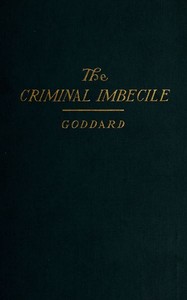
For The Criminal Imbecile: An Analysis of Three Remarkable Murder Cases — Reading Companion, the stored edition analysis reports 37,007 words, 2 hr 41 min estimated reading time, and 4 detected text sections.
The text analysis averages about 22.6 words per sentence, while the detected sections provide another way to judge how the source is divided.
Project Gutenberg metadata also associates the work with “Offenders with mental disabilities -- Case studies,” connecting these edition facts with the source record’s subject description.
Explore this collection
These alternatives are selected using recorded categories and estimated reading time.
About 149 minutes
Adventure Picaresque Fiction
34,075 recorded words. 12 minutes difference from this book's estimate.
View Gutenberg source #75420About 147 minutes
Adventure Picaresque Fiction
33,809 recorded words. 14 minutes difference from this book's estimate.
View Gutenberg source #252About 137 minutes
Adventure Picaresque Fiction
31,388 recorded words. 24 minutes difference from this book's estimate.
View Gutenberg source #56088Search stored excerpts and compare books → Choose by your preferences →
Choices use stored catalog measurements. Estimates vary with reading speed. A shared category is a catalog label, not a claim that two books have the same argument or literary quality.
Search reads excerpt text stored with this catalog and links to its associated Gutenberg record. The connection is stored in the site database; this tool does not recheck that every excerpt is word-for-word identical to that external record. Excerpt search does not cover every chapter and does not verify historical publication dates.
Catalog snapshot checked: 2026-09-26. Coverage: 99 public books, 99 available source excerpts.
Calculated from edition completeness, EPUB availability, text structure and catalogue metadata. Not a user rating.
Total of 100 points, scaled to a 2.5-5.0 range. Editions with an empty description or a missing EPUB file are not scored.
Public-domain source text
The source text is kept in the dedicated reader, separate from this catalogue record and its commentary.
Henry Herbert Goddard’s 1915 study presents three murder cases as evidence that high-grade imbeciles—persons whose mental defect is not immediately obvious—commit crimes in patterns that reflect their specific psychological makeup. The book is structured as a series of case reports, each followed by analysis, and draws heavily on stenographic transcripts of confessions and trial testimony. Goddard, a psychologist at the Vineland Training School, was directly involved in the examinations, and his narrative moves between clinical description and courtroom drama.
The work is notable for its use of the Binet-Simon intelligence tests, which were admitted as evidence in these cases for the first time. Goddard does not simply argue for the defendants’ diminished responsibility; he dissects their language, memory, and behavior to show how imbecility shapes their actions and testimony.
Goddard explicitly contrasts the three defendants to illustrate that imbecility is not a single behavioral type. Jean Gianini is described as “nervous, impulsive, irritable, loquacious,” a braggart and a coward who reads crime stories and craves attention. His confession is “colored by his desire to show off and shine in the limelight.” Roland Pennington, by contrast, is “slow, dull, relatively stupid,” with poor memory and slow perception; his confession is a “plain, unelaborated statement of the facts,” driven by self-defense against a co-defendant’s attempt to shift blame. Fred Tronson, the third case, is characterized by “crude brutality” and a lower grade of defect. This tripartite structure allows Goddard to argue that the same legal and social failure—the inability to recognize high-grade imbeciles—produces different criminal outcomes depending on the individual’s temperament.
Goddard treats the defendants’ own words as primary evidence, analyzing their confessions for signs of defective reasoning rather than simply accepting them as factual accounts. In Gianini’s case, he notes that the boy’s excellent memory and interest in exciting stories produce a narrative that is self-aggrandizing and unreliable. Pennington’s confession, by contrast, is so artless that it incriminates him unnecessarily; Goddard observes that “a little variation in his testimony would have thrown the entire burden upon March and relieved him from any complicity.” The author uses these linguistic and structural differences to argue that imbeciles cannot craft plausible lies or anticipate consequences—a point he reinforces by noting Pennington’s failure to clean up the crime scene or dispose of evidence. The confessions, in Goddard’s hands, become diagnostic tools.
Goddard repeatedly emphasizes that the legal system fails to recognize high-grade imbeciles because laypeople and even medical experts equate imbecility with obvious, low-grade deficiency. In Pennington’s trial, four or five physicians testified to his normality, including a professor of neurology; Goddard counters that these experts were “familiar with what we should call the low-grade type of imbecile” and therefore missed the subtle signs. The jury’s verdict of “guilty in the first degree” is attributed to public demand for revenge, a hastily drawn jury, and a hurried trial—but the root cause, Goddard insists, is ignorance. He points out that Tronson had been before a court previously and was merely ordered to leave town, when institutionalization might have prevented his later crime. The courtroom scenes thus serve as evidence of a systemic blind spot.
The book’s structure alternates between detailed case narratives and analytical chapters, creating a rhythm that mirrors Goddard’s dual role as investigator and advocate. Each case is presented with a chronological account of the crime, arrest, and trial, followed by a chapter that extracts broader principles. For example, after describing Pennington’s dullness and poor judgment, Goddard moves to a chapter titled “The Criminal Imbecile” that generalizes about the type. This back-and-forth allows him to ground his arguments in specific, often grim details—such as Pennington’s failure to wield a blackjack effectively—while also pressing for legal reform. The movement from concrete to abstract is deliberate: Goddard wants the reader to see the human reality behind the clinical category.
Readers should approach this book as a period document in the history of psychology and criminal justice, not as a definitive modern text. Goddard’s terminology and assumptions reflect early 20th-century eugenics and intelligence testing, which have since been critiqued. The value of the work lies in its detailed case presentations and its attempt to use behavioral evidence—speech patterns, memory, decision-making—to argue for a more nuanced understanding of mental defect. Pay attention to the confessions and the expert testimony; they are the raw material from which Goddard builds his case.
I finished the Binet-Simon case studies with the strange ache of seeing how reason can be twisted into verdicts, and found myself thinking about how we hold onto our measures of certainty—even in matters of faith. It reminded me of an old conversation between Littlejohn and his editor, where days and doctrines were weighed like evidence. The Constitutional Amendment: or, The Sunday, the Sabbath, the Change, and Restitution A discussion between W. H. Littlejohn, Seventh-day Adventist, and the editor — Context and Discussion lingers in that same quiet, contested space.
Create a short personal record of your experience with this book.