About 700 minutes
English Poor Law Policy — Themes and Context
Science Fiction Utopias
160,845 recorded words. 203 minutes difference from this book's estimate.
View Gutenberg source #43472
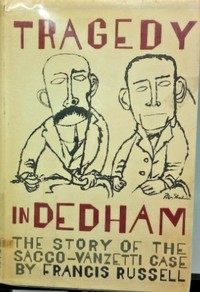
Before opening Tragedy in Dedham — Edition Insights, the edition data offers a quick orientation: 207,592 words, 15 hr 3 min estimated reading time, and 38 detected text sections.
The text analysis averages about 19.7 words per sentence, while the detected sections provide another way to judge how the source is divided.
Project Gutenberg metadata also associates the work with “Sacco-Vanzetti Trial, Dedham, Mass., 1921,” connecting these edition facts with the source record’s subject description.
Explore this collection
These alternatives are selected using recorded categories and estimated reading time.
About 700 minutes
Science Fiction Utopias
160,845 recorded words. 203 minutes difference from this book's estimate.
View Gutenberg source #43472About 473 minutes
Science Fiction Utopias
108,731 recorded words. 430 minutes difference from this book's estimate.
View Gutenberg source #40967About 376 minutes
Science Fiction Utopias
86,431 recorded words. 527 minutes difference from this book's estimate.
View Gutenberg source #56907Search stored excerpts and compare books → Choose by your preferences →
Choices use stored catalog measurements. Estimates vary with reading speed. A shared category is a catalog label, not a claim that two books have the same argument or literary quality.
Search reads excerpt text stored with this catalog and links to its associated Gutenberg record. The connection is stored in the site database; this tool does not recheck that every excerpt is word-for-word identical to that external record. Excerpt search does not cover every chapter and does not verify historical publication dates.
Catalog snapshot checked: 2026-09-26. Coverage: 99 public books, 99 available source excerpts.
Calculated from edition completeness, EPUB availability, text structure and catalogue metadata. Not a user rating.
Total of 100 points, scaled to a 2.5-5.0 range. Editions with an empty description or a missing EPUB file are not scored.
Public-domain source text
The source text is kept in the dedicated reader, separate from this catalogue record and its commentary.
Francis Russell opens his account of the Sacco-Vanzetti case with an epigraph from Ferris Greenslet that wonders whether immortality might be desirable "if only to get at the truth." That longing for a definitive answer shadows the entire narrative. Russell draws on a range of sources—court transcripts, personal diaries, and interviews—to reconstruct the events from the 1920 Bridgewater holdup through the executions and their aftermath. The excerpts show a writer attentive to small, telling details: Sacco gaining twenty-six pounds in prison, a doctor noting his occasional "worried look," and a chance car ride that led to a crucial conversation about bullet evidence.
The excerpts offer a close view of Sacco's time at Bridgewater. Russell records that Sacco entered "cooperative," chatted with other prisoners, polished floors, and worked on the prison farm tending a vegetable garden. His appetite was good—he gained twenty-six pounds in a month. Yet the same man told a doctor, "My mind is clear. I am not crazy," while also admitting that thoughts of suicide still ran through his mind. On July 9, the physician noted that Sacco "says he has not given the suicide idea up, and regrets that he did not die in his former attempt." Immediately after saying this, Sacco looked out the window and watched prisoners playing baseball. Russell lets these juxtapositions stand without commentary, allowing the reader to see the tension between surface adjustment and inner despair.
One of the most striking passages in the excerpts recounts a drive to Swampscott in August 1921. Defense lawyer Elias Field, accompanied by the famous Dr. Hamilton, drove Captain Proctor to his house to examine bullets. During the ride, Proctor told them, "I have been too long in the game, and I'm getting to be too old to want to see a couple of fellows go to the chair for something I don't think they did." When Hamilton asked why Proctor hadn't said more in his testimony about whether Bullet III had gone through Sacco's gun, Proctor replied that if the defense had asked more particularly, "then I should have told them I didn't think it went through that gun." He added that he had told the district attorney before trial he thought it was "consistent with going through that kind of a gun, but I don't think it went through that gun." Field noted the conversation in his diary, and the information eventually reached defense attorney Thompson, who believed it could shatter the prosecution's case—if Proctor would repeat it under oath.
Russell organizes the book chronologically, with chapters covering the crime, the arrests, the trials, and the long post-trial motions. The excerpts show him weaving together multiple threads: the defendants' personal stories, the legal maneuvers, the role of the press, and the growing public protest. He includes a detailed chronology of events from 1919 to 1927, and the table of contents reveals chapters devoted to "The Confessions" and "More History, Written and Otherwise." This suggests a self-consciousness about the writing of history itself—a theme hinted at in the epigraph. The excerpts do not reveal Russell's own conclusions, but they show him assembling evidence from diaries, court records, and interviews, letting the contradictions and ambiguities accumulate.
Readers coming to this book should be prepared for a dense, fact-heavy narrative that moves methodically through the legal process. Russell does not offer a simple verdict; instead, he presents the conflicting accounts and lets the reader weigh the evidence. Pay attention to the footnotes and the sources listed in the acknowledgments—they reveal the range of material Russell consulted. The book is best read with a willingness to sit with uncertainty, much like the judge and jury who had to decide the fate of two men based on testimony that, as the excerpts show, was never as solid as it appeared.
That rainy afternoon, Tragedy in Dedham left me sitting with the feel of old courtrooms and quieter injustices. The verdicts hung in the air like the weather. Later, flipping through a stack of rescued volumes, I happened upon Pictures and Problems from London Police Courts — Inside the Classic. Different city, different century, yet the same weary faces waiting for judgment. It felt less like finding a sequel and more like overhearing an echo from a neighboring room.
Your answers remain private and are stored only in this browser.