About 376 minutes
Pictures and Problems from London Police Courts — Inside the Classic
Science Fiction Utopias
86,431 recorded words. 97 minutes difference from this book's estimate.
View Gutenberg source #56907
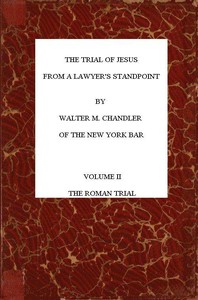
The Trial of Jesus from a Lawyer's Standpoint, Vol. 2 (of 2) The Roman Trial — Reading Companion can be approached with a clearer sense of reading commitment from its source measurements: 108,731 words, 7 hr 53 min estimated reading time, and 13 detected text sections.
The text analysis averages about 23.1 words per sentence, while the detected sections provide another way to judge how the source is divided.
Project Gutenberg metadata also associates the work with “Jesus Christ -- Trial,” connecting these edition facts with the source record’s subject description.
Explore this collection
These alternatives are selected using recorded categories and estimated reading time.
About 376 minutes
Science Fiction Utopias
86,431 recorded words. 97 minutes difference from this book's estimate.
View Gutenberg source #56907About 355 minutes
Science Fiction Utopias
81,568 recorded words. 118 minutes difference from this book's estimate.
View Gutenberg source #49842About 354 minutes
Science Fiction Utopias
81,254 recorded words. 119 minutes difference from this book's estimate.
View Gutenberg source #49230Search stored excerpts and compare books → Choose by your preferences →
Choices use stored catalog measurements. Estimates vary with reading speed. A shared category is a catalog label, not a claim that two books have the same argument or literary quality.
Search reads excerpt text stored with this catalog and links to its associated Gutenberg record. The connection is stored in the site database; this tool does not recheck that every excerpt is word-for-word identical to that external record. Excerpt search does not cover every chapter and does not verify historical publication dates.
Catalog snapshot checked: 2026-09-26. Coverage: 99 public books, 99 available source excerpts.
Calculated from edition completeness, EPUB availability, text structure and catalogue metadata. Not a user rating.
Total of 100 points, scaled to a 2.5-5.0 range. Editions with an empty description or a missing EPUB file are not scored.
Public-domain source text
The source text is kept in the dedicated reader, separate from this catalogue record and its commentary.
Walter M. Chandler, a New York lawyer, approaches the trial of Jesus as a legal scholar, not a theologian. In this second volume, he shifts from the Hebrew trial to the Roman phase, where Pilate and Herod both found Jesus not guilty. Chandler’s method is forensic: he examines Roman criminal law, the powers of the procurator, and the modes of trial in capital cases. The preface explains why no brief is needed—unlike the Hebrew trial, which required an appellate review, the Roman verdicts of acquittal demand a different analysis. Chandler then turns to Græco-Roman paganism, arguing that the multiplicity of gods and the familiarity of Roman religious practice eroded faith and prepared the ground for Christianity.
Chandler structures the Roman trial as a legal problem. He devotes chapters to the twofold jurisdiction of Pilate, the powers and duties of the procurator, and the modes of trial in Roman capital cases. Unlike the Hebrew trial, where the Sanhedrin’s conviction required a detailed brief, the Roman trial is treated as a series of legal questions: Did Pilate have jurisdiction? What was the proper procedure? Chandler cites Roman law and historical sources, but his analysis is constrained by the evidence—he does not claim to reconstruct the trial in full. Instead, he highlights the legal principles that governed Pilate’s actions, such as the provocatio ad Caesarem and the limits on capital punishment in a province. The reader is invited to follow the legal reasoning, not the narrative.
Chandler emphasizes that both Pilate and Herod pronounced Jesus not guilty, a fact that shapes the entire volume. He notes that the Sanhedrin’s conviction was a matter of Hebrew law, while the Roman trial involved charges of treason against Caesar. Chandler’s analysis of Pilate’s role is careful: he examines the procurator’s legal authority and his political pressures, but he does not speculate on Pilate’s motives beyond what the sources suggest. The treatment of Herod is brief, reflecting the scant evidence. Chandler’s focus remains on the legal implications of the acquittals, arguing that they expose the illegality of the Hebrew trial. This section is dense with citations to Roman jurists and historians, but Chandler avoids overinterpreting the gaps in the record.
Part II of the volume shifts from law to religion and society. Chandler describes the Græco-Roman pantheon, the Lectisternia (banquets of the gods), and the skepticism that arose from overfamiliarity with deities. He quotes Seneca and Cicero to illustrate the decline of religious reverence. The legal mind is still at work: Chandler treats paganism as a system of beliefs that shaped Roman law and governance. He notes that the multiplicity of gods led to a loss of faith, which in turn created a vacuum that Christianity filled. This section is less about the trial itself and more about the cultural environment in which it occurred. Chandler’s tone is analytical, not devotional, and he relies on ancient sources to support his claims. The reader gains a sense of the intellectual and religious currents that influenced Pilate’s world.
Chandler writes in a formal, legal style, with frequent references to statutes and historical authorities. His voice is that of a barrister presenting a case: he uses rhetorical questions, cites precedents, and structures his arguments in numbered points. The pace is deliberate, with long paragraphs that build a cumulative case. In the pagan section, the tone shifts slightly—more descriptive, less argumentative—but the legal framework remains. Chandler’s language is precise, avoiding emotional appeals. He uses Latin terms (provocatio, imperium) and quotes classical authors, but he always translates or explains them. The reader is treated as a fellow legal professional, not a layperson. This consistent voice gives the volume a unified, scholarly feel, even when the subject matter changes.
The volume is divided into two distinct parts, and the pace shifts noticeably. Part I, on the Roman trial, is tightly focused: each chapter addresses a specific legal issue, and the argument moves quickly from jurisdiction to verdict. Chandler assumes the reader is familiar with the Hebrew trial from Volume 1, so he does not rehash facts. Part II, on Græco-Roman paganism, is more leisurely. Chandler describes religious practices, social life, and philosophical trends in a broader, more narrative style. The footnotes multiply, and the prose becomes more expansive. This change in pace reflects Chandler’s purpose: the first part is a legal brief, the second a cultural survey. Readers should be prepared for this shift, which mirrors the volume’s dual focus on law and context.
Chandler’s volume rewards readers who approach it as a work of legal history rather than devotional literature. The careful distinction between the Hebrew and Roman trials, the emphasis on Pilate’s acquittal, and the detailed examination of Roman law all contribute to a fresh perspective on a familiar story. The second part, on paganism, provides essential context but requires patience. For those interested in the intersection of law, religion, and history, this book offers a rigorous, if dated, analysis.
There’s something achingly familiar in how Chandler walks us through Pilate’s courtroom—the careful law, the quiet misgivings, the pressure of a crowd. It made me think of another old transcript, The Tryal of William Penn & William Mead for Causing a Tumult at the Sessions Held at the Old Bailey in London the 1st, 3d, 4th, and 5th of September 1670 — Inside the Classic, where a judge also wouldn’t hear the defense. Centuries apart, same stubborn echo.
A brief reflection can help important ideas stay with you longer.