About 52 minutes
The Universal Counterfeit and Altered Bank Note Detector, at Sight — A Closer Reading
Science Fiction Utopias
11,846 recorded words. 1 minutes difference from this book's estimate.
View Gutenberg source #53907
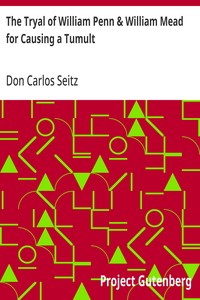
The catalog record for The Tryal of William Penn & William Mead for Causing a Tumult at the Sessions Held at the Old Bailey in London the 1st, 3d, 4th, and 5th of September 1670 — Inside the Classic provides practical reading context through 11,973 words, 53 min estimated reading time, and 2 detected text sections.
The text analysis averages about 21.7 words per sentence, while the detected sections provide another way to judge how the source is divided.
Project Gutenberg metadata also associates the work with “Mead, William, 1628-1713 -- Trials, litigation, etc.,” connecting these edition facts with the source record’s subject description.
Explore this collection
These alternatives are selected using recorded categories and estimated reading time.
About 52 minutes
Science Fiction Utopias
11,846 recorded words. 1 minutes difference from this book's estimate.
View Gutenberg source #53907About 62 minutes
Science Fiction Utopias
14,217 recorded words. 9 minutes difference from this book's estimate.
View Gutenberg source #66938About 35 minutes
Science Fiction Utopias
7,890 recorded words. 18 minutes difference from this book's estimate.
View Gutenberg source #26870Search stored excerpts and compare books → Choose by your preferences →
Choices use stored catalog measurements. Estimates vary with reading speed. A shared category is a catalog label, not a claim that two books have the same argument or literary quality.
Search reads excerpt text stored with this catalog and links to its associated Gutenberg record. The connection is stored in the site database; this tool does not recheck that every excerpt is word-for-word identical to that external record. Excerpt search does not cover every chapter and does not verify historical publication dates.
Catalog snapshot checked: 2026-09-26. Coverage: 99 public books, 99 available source excerpts.
Calculated from edition completeness, EPUB availability, text structure and catalogue metadata. Not a user rating.
Total of 100 points, scaled to a 2.5-5.0 range. Editions with an empty description or a missing EPUB file are not scored.
Public-domain source text
The source text is kept in the dedicated reader, separate from this catalogue record and its commentary.
The trial of William Penn and William Mead, transcribed from the 1719 Compleat Collection of State Tryals, opens not with a legal argument but with a structural oddity: the defendants themselves are credited as the authors of the account. This self-recorded narrative immediately signals that the text is as much a document of resistance as a record of proceedings. The foreword by editor Don Carlos Seitz frames Penn as a singular figure who "absorb and fulfill the requirements" of Quaker faith, yet the excerpts that follow show a courtroom drama where the prisoners' voices are repeatedly suppressed by the bench.
The recorder and mayor employ a lexicon of menace that reveals the stakes of the trial. When juror Edward Bushel hesitates to deliver a guilty verdict, the recorder threatens: "I shall set a Mark upon you, Sir." Mayor Sir John Robinson follows with personal attacks, claiming Bushel "thrust your self upon this Jury" and deserves indictment more than the prisoners. The language escalates from legal warning to personal vilification—"impudent Fellow," "void of Justice"—exposing the bench's frustration with a jury that refuses to comply. This pattern of intimidation, documented in the Observations interjected by the defendants, transforms the courtroom into a site of power struggle rather than impartial judgment.
When the jury returns with a written verdict, they do not simply acquit or convict. They specify: William Penn is "Guilty of Speaking or Preaching to an Assembly" in Gracechurch Street, but William Mead is "Not guilty of the said Indictment." This careful wording, delivered by foreman Thomas Veer, rejects the court's framing of an "unlawful Assembly." The jurors—named individually in the text—stand by their distinction, even as the recorder insists they "had as good say nothing." The jury's insistence on pen, ink, and paper to craft this precise response demonstrates a deliberate act of legal literacy, using the tools of the court to resist its coercion.
The defendants are not passive figures. The transcript notes they were kept in "the stinking Hole" while the jury deliberated, a detail that underscores the physical degradation of the accused. Yet their voice persists through the Observations that punctuate the official record, describing the bench's behavior as "barbarous Usage" and noting the court's "imperious" manner. This dual narrative—the official transcript and the defendants' commentary—creates a layered text where the prisoners reclaim narrative authority. The editor Seitz's foreword, which praises Penn as "more than ordinary Man," sets the stage for this tension, but the excerpts themselves show a collective act of defiance by jury and defendants alike.
Don Carlos Seitz, the editor, frames the trial within a hagiographic tradition, dedicating the volume to Thomas Jefferson and asserting Penn's unique role in establishing "Liberty, Equality and Fraternity." Yet the text itself is a transcription from the 1719 Compleat Collection of State Tryals, a source that already shaped the narrative for eighteenth-century readers. The Project Gutenberg edition, released in 2005, adds another layer: the metadata categorizes it as "Science Fiction & Utopias," a curious classification that highlights how Penn's trial has been repurposed as a founding myth of American liberty. Readers should approach the text aware that its presentation—from Seitz's foreword to the digital formatting—carries interpretive weight.
Reading this trial transcript requires attention to its multiple voices: the court's threats, the jury's precise language, and the defendants' editorial interjections. The text is not a neutral record but a contested document, shaped by its original compilers and later editors. For a first reading, focus on the exchanges between the bench and the jury—particularly the moments when the jurors demand paper and the recorder resorts to personal attacks. These passages reveal the mechanics of legal resistance and the fragility of judicial authority in seventeenth-century London.
Reading that old transcript, I kept thinking how the jury’s stubborn "not guilty" must have felt like a small, quiet inheritance—a refusal handed down. It reminded me of the careful, almost tender language in The Will of Samuel Appleton, with Remarks by One of the Executors — A Closer Reading, where every clause carries a weight beyond its words, like a hand pressing firmly on a page centuries later.
Build a private reading journal entry for this title.