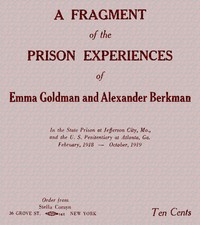
A fragment of the prison experiences of Emma Goldman and Alexander Berkman In the State Prison at Jefferson City, Mo., and the U. S. Penitentiary at Atlanta, Ga. February — A Reader’s Guide

(0 User reviews)   712
Goldman, Emma, 1869-1940, Berkman, Alexander, 1870-1936 Project Gutenberg 2021 Not confirmed
Anarchists -- United States; Goldman, Emma, 1869-1940; Berkman, Alexander, 1870-1936; Prisoners -- United States Readers of public-domain and historical texts
Project Gutenberg digital edition en

Edition facts

Words 14,217
Reading time 62 min
Text sections 14

For A fragment of the prison experiences of Emma Goldman and Alexander Berkman In the State Prison at Jefferson City, Mo., and the U. S. Penitentiary at Atlanta, Ga. February — A Reader’s Guide, the stored edition analysis reports 14,217 words, 1 hr 2 min estimated reading time, and 14 detected text sections.

The text analysis averages about 21.6 words per sentence, while the detected sections provide another way to judge how the source is divided.

Project Gutenberg metadata also associates the work with “Anarchists -- United States,” connecting these edition facts with the source record’s subject description.

Explore this collection

Compare your next read

These alternatives are selected using recorded categories and estimated reading time.

Search stored excerpts and compare books → Choose by your preferences →

How these choices and excerpts are prepared

Choices use stored catalog measurements. Estimates vary with reading speed. A shared category is a catalog label, not a claim that two books have the same argument or literary quality.

Search reads excerpt text stored with this catalog and links to its associated Gutenberg record. The connection is stored in the site database; this tool does not recheck that every excerpt is word-for-word identical to that external record. Excerpt search does not cover every chapter and does not verify historical publication dates.

Catalog snapshot checked: 2026-09-26. Coverage: 99 public books, 99 available source excerpts.

This editorial note examines how the opening foreword, middle rebuttal, and later excerpts of Goldman and Berkman's prison fragment guide a first reading, focusing on rhetorical strategy, structural shifts, and specific details like the 'dark hole' cell.
Share
Editorial Edition Score 4.7/5

Calculated from edition completeness, EPUB availability, text structure and catalogue metadata. Not a user rating.

How this score is calculated
  • Description quality20 pts
  • Title & short description10 pts
  • Source metadata20 pts
  • Text length15 pts
  • Chapters / structure15 pts
  • EPUB file integrity20 pts

Total of 100 points, scaled to a 2.5-5.0 range. Editions with an empty description or a missing EPUB file are not scored.

Edition quality

Public-domain source text

Read the source text

The source text is kept in the dedicated reader, separate from this catalogue record and its commentary.

The foreword to this fragment immediately establishes a polemical framework: it compares contemporary attitudes toward criminals to historical treatment of the insane, arguing that crime is a product of environment rather than innate evil. The authors cite Lombroso's theories as 'thoroughly exploded' and claim that 97 percent of crime stems from economic institutions. This opening does not describe prison conditions directly but instead lays out a sociological argument that will underpin the subsequent accusations.

From Foreword to Indictment

The foreword functions as a theoretical preface, but the middle excerpts shift abruptly to specific allegations. Berkman responds to Warden Zerbst's public denial of abuses, naming Deputy Warden Girardeau and detailing the 'dark hole' punishment cell. The text moves from abstract claims about criminality to concrete measurements: the cell is 'about 2½ feet wide at the entrance, 4½ feet at the back, and 6 feet long.' This transition from general argument to particular evidence is the fragment's central rhetorical move.

The Rhetoric of Refutation

Berkman's rebuttal is structured as a point-by-point challenge to the warden's statements. He accuses Zerbst of misplaced 'chivalry' toward subordinates and contrasts the warden's defense with the earlier Moyer-Hawthorne scandal. The prose is direct and confrontational: 'I emphatically challenge the Warden’s statement that visitors are admitted to the punishment cells I described as filthy.' This section reveals the fragment's origin as a public defense against official denial, giving it the tone of a legal brief or newspaper rejoinder.

Details as Evidence

The most striking passages are those that describe physical conditions. The 'dark hole' is rendered in precise, grim detail: a wedge-shaped space with a floor mattress, a rag for covering, and an open iron pail emptied once daily. Berkman specifies that prisoners are kept there for 'thirty days consecutively and sometimes longer' on bread and water. These details serve not as literary description but as documented evidence intended to be verifiable. The fragment's power lies in such concrete accusations rather than in narrative or reflection.

The Fragmentary Form

The text is explicitly a 'fragment'—it covers only February 1918 to October 1919 and does not claim completeness. The excerpts break off mid-sentence, and the later portions shift to Project Gutenberg's standard boilerplate. This abrupt ending underscores the unfinished nature of the work. Readers should note that the fragment does not provide a full account of Goldman and Berkman's imprisonment; it is a targeted polemic responding to specific public statements. The absence of narrative continuity means each section must be read as a discrete argumentative unit.

Because this fragment is a response to a specific controversy, first-time readers may benefit from knowing that the authors were anarchists imprisoned under the Espionage Act. The text assumes familiarity with the public exchange between Berkman and Warden Zerbst. Pay attention to how the foreword's theoretical claims about crime and environment are tested against the later, highly specific charges—the fragment's coherence depends on this link between abstract argument and concrete accusation.

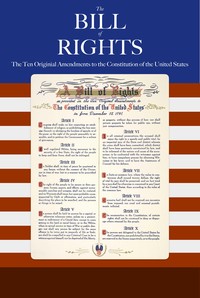
Reading about the “dark hole” cell, I paused, remembering the stifling quiet of a childhood closet I once hid in. The cold certainty of those prison walls felt oddly familiar. That same sense of rights suspended came back years later, holding a worn copy of The United States Bill of Rights The Ten Original Amendments to the Constitution of the United States — Edition Insights. Both texts whispered the same truth—freedom is only fully felt in its absence.

There are no reviews for this eBook.

0
0 out of 5 (0 User reviews )

Add a Review

Your Rating *
There are no comments for this eBook.

Reader reflection

What did you think of this book?

Answer a few questions and save a private reflection on this device.

Your progress 0 / 10
1

What is your current status with this title?

2

What was your overall reaction to the book?

3

Would you encourage someone else to read it?

4

How demanding did the text feel?

Related eBooks