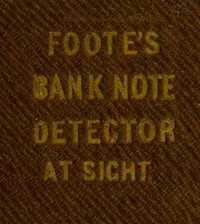
H. C. Foote's 1853 manual presents a seven-rule system for detecting counterfeit and altered bank notes at sight, a practical skill in an era when hundreds of banks issued their own paper currency. The book opens with testimonials from bank cashiers, exchange brokers, and even the Chief of Police of New York, vouching for Foote's method. Rather than relying on chemical tests or watermarks, Foote trains the eye to scrutinize the engraving itself—the stippling, the human face, the drapery, the lettering—arguing that genuine notes are produced by a division of labor among ten to fifteen master engravers, a standard counterfeiters cannot match.
The Seven Rules as a Visual Grammar
Foote organizes his method into seven numbered rules, each targeting a specific element of bank note design: paper, ink, engraving, vignette, lettering, and so on. The fourth rule, on the vignette, receives the most detailed treatment. Foote instructs the reader to examine the human face first, noting that in genuine notes the eyes have a “perfectly natural expression,” while in counterfeits they are “merely two clumsy dots.” He extends this scrutiny to stippling—the fine dots that create shading—which in counterfeits appears “flat, scratchy, inexpressive, and inanimate.” The hair, drapery, limbs, and even smoke are each given their own diagnostic criteria. This systematic breakdown transforms the bank note into a text to be read for authenticity.
The Language of Defect: Scratchy, Stiff, Wiry
Foote’s diction reveals a connoisseur’s eye for craft. Counterfeit drapery, he writes, can look like “cast iron” or “coarse wire-cloth, inexplicably twisted up in a snarl.” Genuine hair is “soft, silky, and natural”; counterfeit hair is “stiff, coarse, wiry, lifeless, and unnatural.” The repeated adjectives—scratchy, stiff, coarse—create a consistent vocabulary of failure. Foote does not merely list defects; he evokes the tactile and visual experience of poor engraving. This language serves a dual purpose: it trains the reader’s perception and builds confidence that the difference between genuine and counterfeit is not subtle but glaring once one knows what to look for.
The Authority of the Divided Labor Argument
Foote bolsters his method with a quotation from Chambers’s Information for the People, which explains that genuine bank note plates are the work of ten to fifteen artists, each executing a separate part. “It is therefore evident that no band of counterfeiters can accomplish their designs—it being impossible,” the passage concludes. This argument from industrial scale is central to Foote’s rhetorical strategy: the perfection of the genuine note is not merely a matter of skill but of organization. Counterfeiters, he implies, are necessarily inferior—runaway apprentices, cast-off journeymen, amateurs. The reader is thus positioned as an expert who can spot the telltale signs of a lone, under-resourced forger.
The Reader as Detective: Practical Application
Foote’s manual is designed for self-instruction, with diagrams and illustrations on steel plates. The text repeatedly addresses the reader directly, as in “notice whether the ‘perspective’ is managed rightly.” The seventh rule likely covers the overall impression, but the excerpts show Foote’s emphasis on the vignette as the most revealing element. The book’s structure—short rules followed by detailed commentary—mirrors a classroom lecture. Foote’s tone is authoritative but not pedantic; he assumes the reader can learn to see what he sees. The testimonials from bank professionals reinforce this democratic promise: anyone who studies the system can become a competent detector.
Foote’s detector is a document of its time, when paper currency was a chaotic patchwork of private issues and counterfeiting was rampant. But it is also a remarkably precise work of visual education, teaching a method of close looking that applies to any engraved image. Readers interested in the history of printing, forgery, or nineteenth-century commerce will find in these pages a vivid record of how authenticity was once determined—one stippled dot at a time.
That rainy afternoon, I kept returning to Foote's insistence that the smallest flaw—a broken hairline in a vignette—could unmask a forgery. It made me think of other quiet judgments, of signs too easily mistaken. Later, I found myself drifting to On the uncertainty of the signs of murder in the case of bastard children — Reading Notes, where certainty itself becomes the suspect. Both books share that hush of careful looking, and the fear of being wrong.