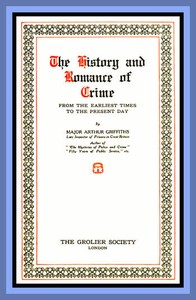
Millbank Penitentiary: An Experiment in Reformation — Background and Themes

(0 User reviews)   726
Griffiths, Arthur, 1838-1908 Project Gutenberg 2015 Not confirmed
Prisons -- Great Britain -- History; Millbank Prison (London, England); Penal colonies Readers of public-domain and historical texts
Project Gutenberg digital edition en

Edition facts

Words 81,254
Reading time 354 min
Text sections 19

Millbank Penitentiary: An Experiment in Reformation — Background and Themes can be approached with a clearer sense of reading commitment from its source measurements: 81,254 words, 5 hr 54 min estimated reading time, and 19 detected text sections.

The text analysis averages about 23.2 words per sentence, while the detected sections provide another way to judge how the source is divided.

Project Gutenberg metadata also associates the work with “Prisons -- Great Britain -- History,” connecting these edition facts with the source record’s subject description.

Explore this collection

Compare your next read

These alternatives are selected using recorded categories and estimated reading time.

Search stored excerpts and compare books → Choose by your preferences →

How these choices and excerpts are prepared

Choices use stored catalog measurements. Estimates vary with reading speed. A shared category is a catalog label, not a claim that two books have the same argument or literary quality.

Search reads excerpt text stored with this catalog and links to its associated Gutenberg record. The connection is stored in the site database; this tool does not recheck that every excerpt is word-for-word identical to that external record. Excerpt search does not cover every chapter and does not verify historical publication dates.

Catalog snapshot checked: 2026-09-26. Coverage: 99 public books, 99 available source excerpts.

An examination of Millbank Prison's origins, design, and daily operations, drawn from official records and firsthand accounts. The text focuses on the tension between reformist ideals and the practical challenges of confinement, including detailed narratives of escape attempts and disciplinary measures.
Share
Editorial Edition Score 4.8/5

Calculated from edition completeness, EPUB availability, text structure and catalogue metadata. Not a user rating.

How this score is calculated
  • Description quality20 pts
  • Title & short description10 pts
  • Source metadata20 pts
  • Text length15 pts
  • Chapters / structure15 pts
  • EPUB file integrity20 pts

Total of 100 points, scaled to a 2.5-5.0 range. Editions with an empty description or a missing EPUB file are not scored.

Edition quality

Public-domain source text

Read the source text

The source text is kept in the dedicated reader, separate from this catalogue record and its commentary.

Millbank Penitentiary, a 'gloomy pile by the river side' with 'black portals' and 'curious towers,' stood on the Thames between Westminster and Vauxhall for nearly a century. Arthur Griffiths, a former prison inspector, draws on official records and personal observation to recount its history. The book opens with the prison's conception by John Howard and Jeremy Bentham, then moves through its construction and the early years of operation. Griffiths emphasizes the 'intimate personal communion' between high-ranking committee members and inmates, a feature that sets Millbank apart from later penal institutions.

The Architecture of Reform

The prison's design was itself a statement of intent. Howard's plan, quoted at length, proposed that convicts build their own cells, starting with the 'surrounding wall, intended for full security against escapes.' Griffiths notes that an 'architect of eminence' oversaw the work, and the committee—composed of 'dukes, bishops, and members of Parliament'—involved itself in 'minutest details.' The physical layout, with its 'curious towers' and isolated cells, was meant to enforce reflection and discipline. Yet the same walls that symbolized order also became obstacles: the narrative later describes how prisoners exploited 'the present unsafe condition of the prison, owing to the extensive repairs' to plan escapes.

The Governor's Dilemma: Pickard Smith

A substantial portion of the excerpts follows the case of Pickard Smith, a prisoner whose repeated escape attempts baffled the governor, Mr. Nihil. Smith's resourcefulness is detailed: he tore blankets into strips for scaling, fashioned a picklock from a piece of metal hidden in his stocking, and even removed a staple from a dark cell door to work at the wall. Nihil's reports to the committee reveal a growing frustration. He writes that Smith 'has already experienced [corporal punishment] very severely without any beneficial effect' and that his 'knowledge of the localities' makes perpetual attempts inevitable. When offered removal of handcuffs in exchange for a promise not to escape, Smith refuses: 'I'll never make another promise as long as I am here.' The governor's language—'I cannot but lament that the powerful qualities he possesses should have been so greatly perverted'—shows a reformist ideology struggling with an inmate who refuses to be reformed.

Discipline and Its Limits

The excerpts show a system constantly improvising. Smith is moved from cell to cell, placed in a 'strong room,' handcuffed, and finally put in a dark cell—yet he continues to cause disturbance. The governor's request to 'get rid of this prisoner' highlights the prison's inability to contain a determined individual. Griffiths presents these incidents not as anomalies but as evidence of the gap between theory and practice. The committee's close oversight, meant to ensure humane treatment, also creates a paper trail that documents failure. The narrative does not resolve Smith's story; instead, it leaves the reader with the image of a governor 'almost bewildered,' caught between the ideal of reformation and the reality of a prisoner who declares, 'there isn't a part from which I couldn't escape.'

Readers should approach this work as a case study in institutional history rather than a complete chronicle. The excerpts focus heavily on the prison's early decades and on a few dramatic episodes, leaving later developments and broader statistical trends unexplored. Griffiths's reliance on committee minutes and governors' reports gives the narrative a bureaucratic texture, but it also preserves voices—like Smith's—that official records rarely capture. The book rewards those interested in the practical contradictions of penal reform.

Reading about Millbank’s orderly corridors and its stubborn, human flaws, I found myself drifting to another kind of confinement—the furious, articulate letters from Jefferson City. Both books measure the distance between the stated purpose of a prison and the quiet weight of its days. That same ache for reform, met by walls, lingers in A fragment of the prison experiences of Emma Goldman and Alexander Berkman In the State Prison at Jefferson City, Mo., and the U. S. Penitentiary at Atlanta, Ga. February — A Reader’s Guide.

There are no reviews for this eBook.

0
0 out of 5 (0 User reviews )

Add a Review

Your Rating *
There are no comments for this eBook.

Reader reflection

How did this book work for you?

Your answers remain private and are stored only in this browser.

Your progress 0 / 10
1

What is your current status with this title?

2

How much did you enjoy the reading experience?

3

Is this a title you would suggest to others?

4

How demanding did the text feel?

Related eBooks